

Blog
The Complete History of Fountain Pens From Invention to Modern Luxury

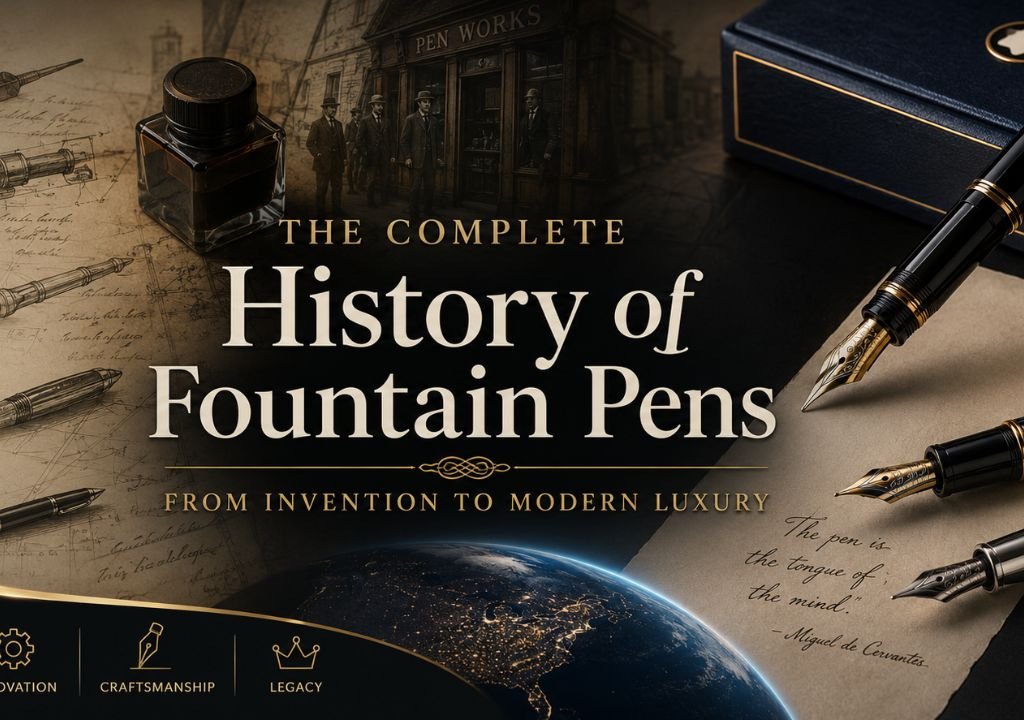
A thousand-year journey from a Fatimid caliph’s court in 973 AD to the Montblanc Meisterstücks and Japanese maki-e masterpieces of today.
TABLE OF CONTENTS
- Before the fountain pen
- First pen, 973 AD
- Early experiments
- 19th-century race
- Waterman & Sheaffer
- Parker, Pelikan, Montblanc
- Japan — Pilot, Sailor
- The ballpoint threat
- Reinvention as luxury
- Fountain pens in India
- Pens that made history
CHAPTER 1
Before the fountain pen a world ink-stained by struggle
To understand why the fountain pen was such a revolution, you must first understand the misery of writing before it. For most of recorded history, people wrote with a reed pen or quill — a feather cut to a point and dipped in a pot of ink. Every few words, the writer had to stop, dip again, and hope the ink did not drip, blot, or run dry at a crucial moment. Scribes in ancient Egypt used reed pens around 3000 BCE. Medieval monks illuminated manuscripts with goose quills. Even Shakespeare wrote with a quill, pausing to re-dip after every sentence or two. The dip pen improved somewhat on the quill, but the fundamental problem remained: the ink supply was always external. You were permanently tethered to your inkwell. A knock of the elbow could mean catastrophe — ruined parchment, stained clothing, hours of work destroyed. The dream, then, was simple: a pen that carried its own ink. A pen that flowed continuously. A pen that freed the writer from the tyranny of the inkpot.
“The best pen isn’t the most expensive one. It’s the one that makes you want to write.”
CHAPTER 2
The first fountain pen a royal request, 973 AD
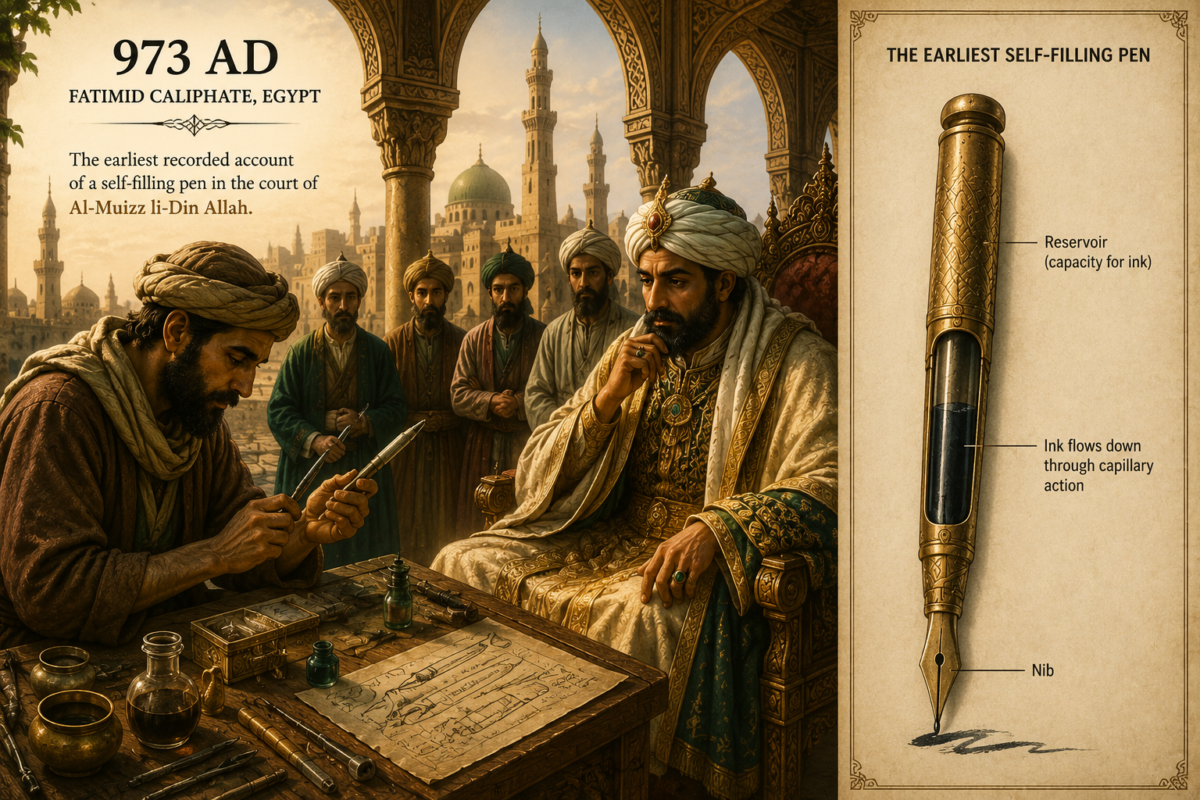
Most people assume the fountain pen is a 19th-century invention. It is not. The earliest recorded account of a self-filling pen dates to 973 AD, in the court of Al-Muizz li-Din Allah, the Fatimid Caliph of Egypt. According to the medieval chronicle Kitab al-Majalis wa ‘l-musayarat by the scholar Al-Qadi al-Nu’man, the Caliph demanded a pen that would not stain his hands or robes. His craftsmen obliged — constructing a pen with an internal reservoir of ink that fed to the nib through capillary action. The pen reportedly worked. But the design was not recorded in technical detail, and the invention was not replicated or distributed. It remained a curiosity of the royal court — remarkable, but forgotten by history. The idea would not resurface in any meaningful way for another seven centuries.
CHAPTERS 4 – 6
The founding era Waterman, Parker, Pelikan & Montblanc
Key milestones in the birth of the modern fountain pen industry:
Romanian inventor, Paris
Petrache Poenaru receives first modern fountain pen patent
The first commercially successful pen
Lewis Waterman patents the three-fissure feed
Shocked a market accustomed to black
Parker Duofold launches in bold orange hard rubber
The pen that defined luxury writing
Montblanc Meisterstück introduced
Designed by Theodor Kovacs still used today
Pelikan Model 100 with piston-fill mechanism
CHAPTER 7
Japan enters the stage — Pilot, Sailor, Platinum
While Europe dominated the early fountain pen world, Japan was quietly building a tradition that would eventually rival — and in many ways surpass — Western craftsmanship.
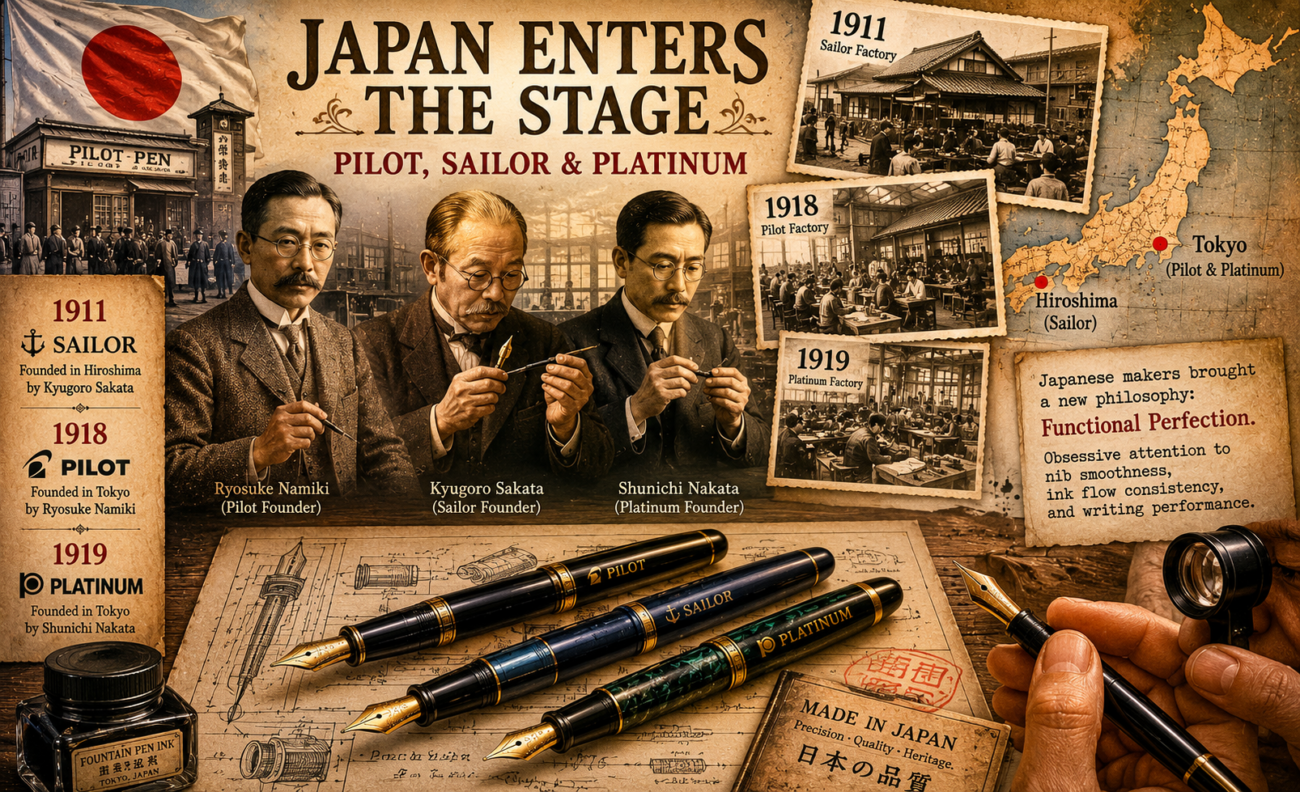
Pilot Corporation was founded in Tokyo in 1918 by Masao Wada and Ryosuke Namiki. The company’s early pens were inspired by Western models but rapidly developed a distinctly Japanese sensibility — precise, reliable, and beautifully finished. Pilot’s Custom 74 and, later, the legendary Pilot Custom 823 became benchmarks of Japanese fountain pen engineering.
Sailor was founded in Hiroshima in 1911, named after the sailors who brought foreign pens to Japan for repair. Sailor became renowned for nib craftsmanship — particularly its naginata nib, a uniquely curved design that produces a stunning variation in line width depending on the angle of writing.
Platinum Pen Company (founded 1919) contributed the development of slip-and-seal cap technology and later pioneered the revolutionary 3776 Century — a pen designed to be leak-proof even on aeroplanes.
Japanese pen-making brought a new philosophy to the craft: functional perfection. Where European pens often prioritised beauty and prestige, Japanese manufacturers obsessed over the writing experience itself — the smoothness of the nib, the consistency of ink flow, the precision of the feed.
CHAPTER 8
The Ballpoint Threat — The Near-Death of the Fountain Pen
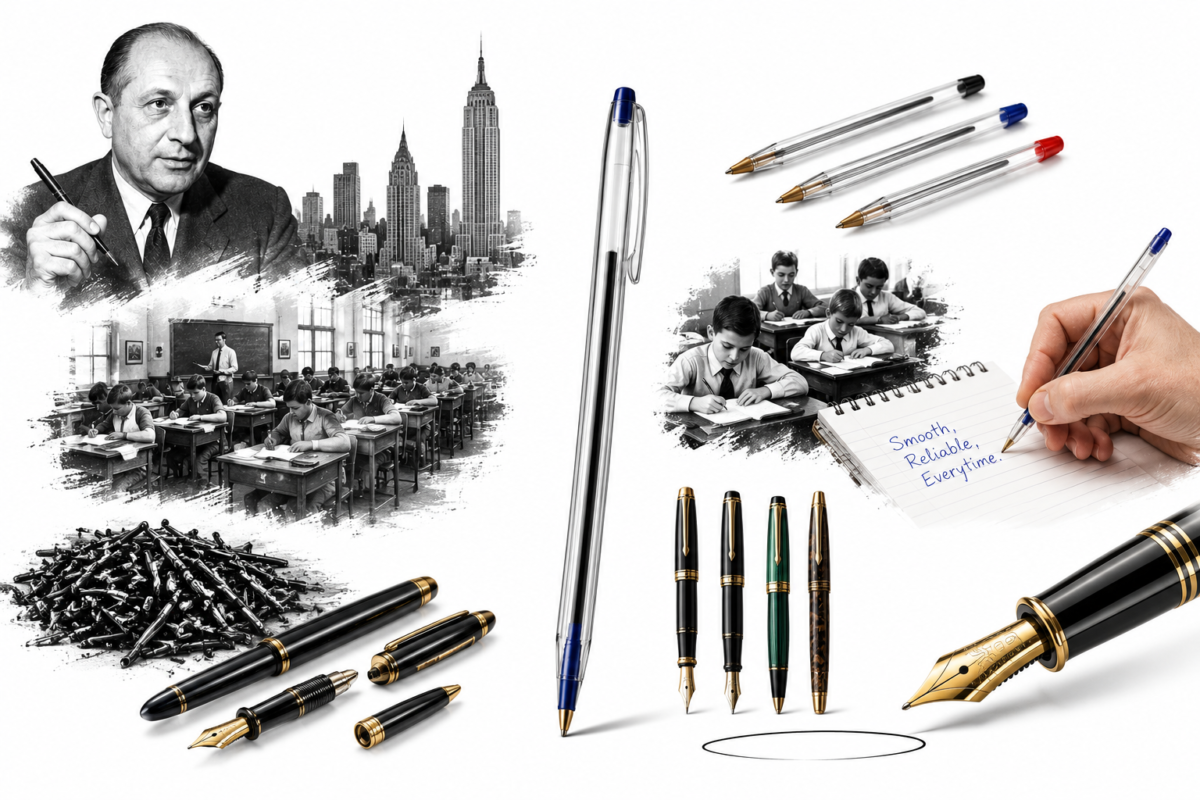
In 1943, Hungarian-Argentine journalist László Bíró patented the ballpoint pen, and in 1945, the first ballpoint pens went on sale in the United States. They were marketed as revolutionary: no leaking, no drying out, works upside down, requires no special ink. The fountain pen industry watched with growing alarm. Through the 1950s and 1960s, ballpoint pens became cheaper and more reliable. Governments adopted them. Schools switched from the careful pen-and-nib lessons of the earlier era to the biro. The fountain pen, for the first time in its existence, looked like it might become obsolete. Many pen companies collapsed. Others pivoted to ballpoints. The great American manufacturers — Wahl-Eversharp, Conklin, Eagle Pencil — faded away. Even Parker and Sheaffer struggled. But the fountain pen did not die. It did something more interesting: it transformed.
CHAPTER 9
Reinvention as Luxury — The Modern Era (1980s–Today)
What saved the fountain pen was a shift in identity. Unable to compete with ballpoints on convenience and price, fountain pens stopped trying to be everyday tools and embraced what they had always been at their finest: objects of beauty, craftsmanship, and self-expression.
Montblanc led this reinvention in the 1980s, aggressively positioning its pens alongside watches and jewellery as markers of taste and success. The fountain pen became aspirational — something you were given at graduation, bought to mark a promotion, or chose as a daily companion that reflected who you were.
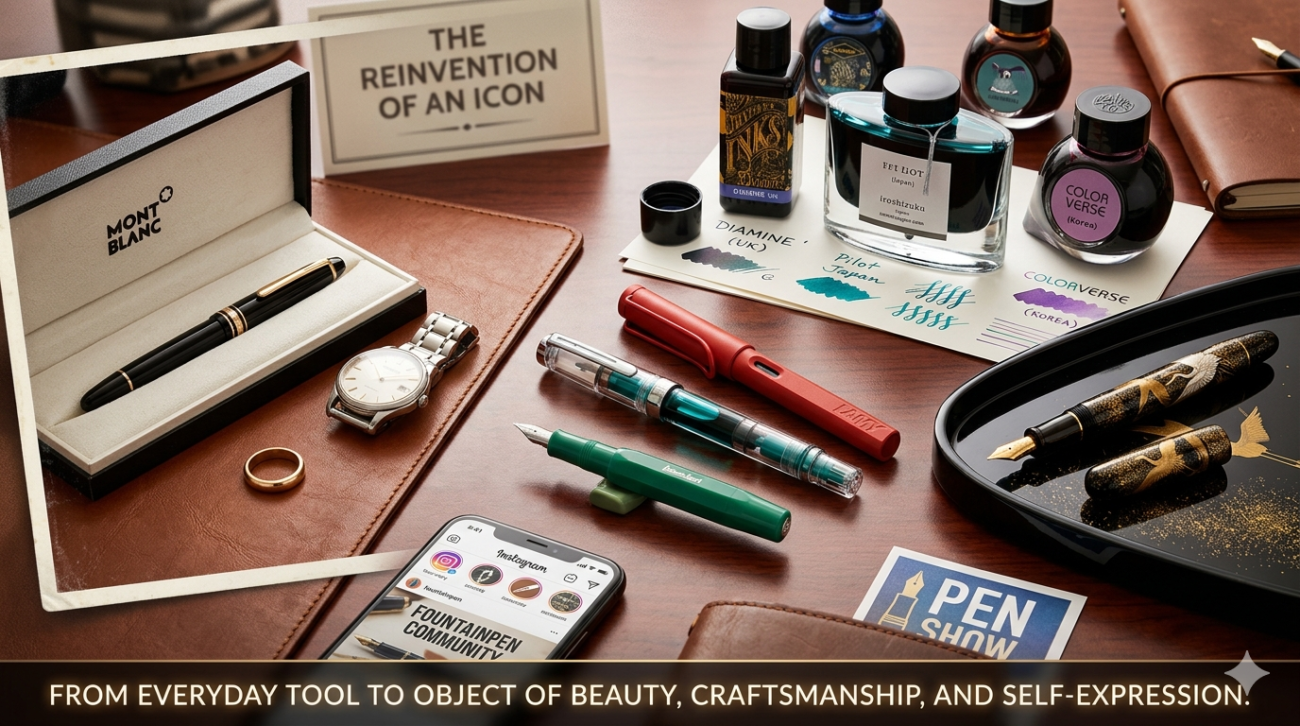
Meanwhile, a passionate enthusiast community kept the craft alive from the ground up. Pen shows proliferated. Ink manufacturers like Diamine (UK), Iroshizuku by Pilot (Japan), and Colorverse (Korea) began producing dozens — then hundreds — of extraordinary ink colours that turned filling a pen into a form of self-expression. Forums, YouTube channels, and Instagram accounts dedicated to fountain pens attracted millions of followers.
New brands emerged to serve this community. LAMY (Germany) made fountain pens accessible and stylishly functional with its iconic LAMY Safari — a pen for students and beginners that refused to be boring. TWSBI (Taiwan) brought see-through demonstrator pens with mechanical filling systems to an affordable price point. Kaweco revived its 1930s Sport pen design to cult status. Visconti and Montegrappa pushed fountain pen design into wearable sculpture, producing pens inlaid with precious stones, volcanic lava, and rare materials.
In Japan, the art of maki-e — traditional Japanese lacquerware decoration involving gold and silver powders applied to lacquered surfaces — was adapted for fountain pens, producing instruments of staggering beauty by houses like Namiki, Pilot, and Sailor. These pens are not merely writing instruments; they are paintings you hold.
CHAPTER 10
Fountain Pens in India — A Rich and Growing Culture
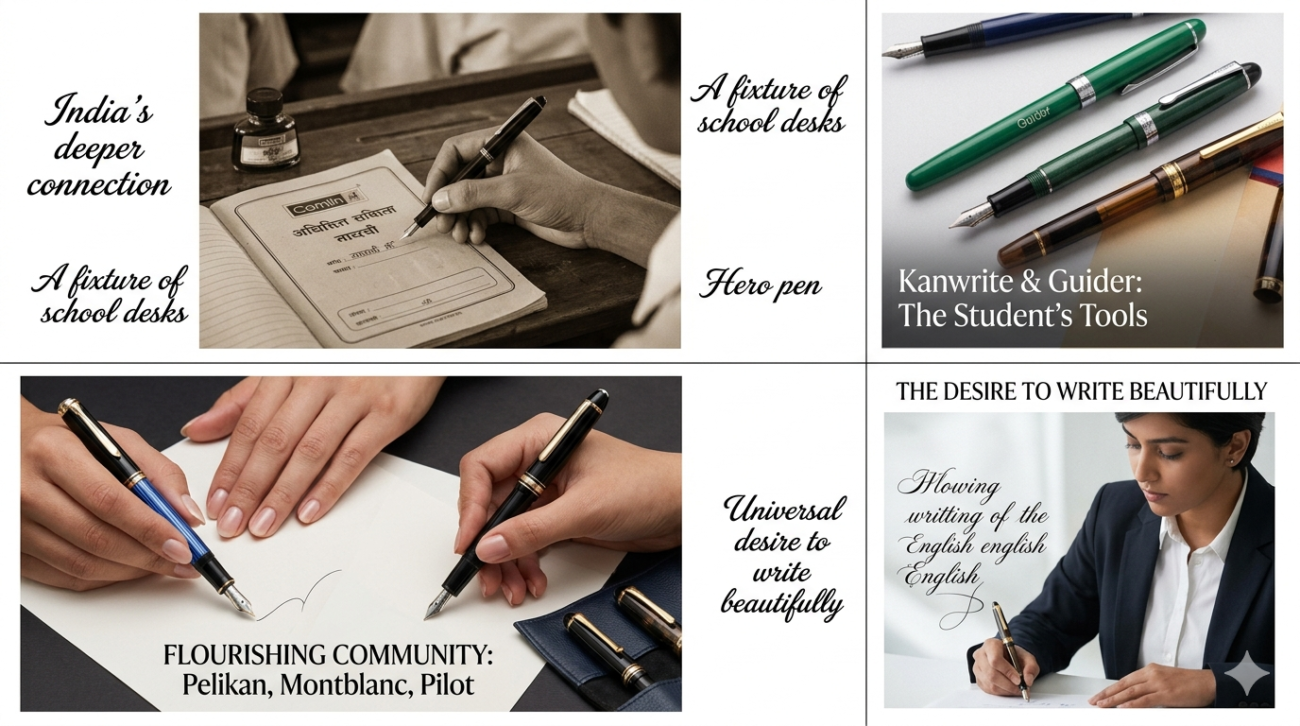
India has a deeper connection to fountain pens than many people realise. The Hero pen (originally a Chinese brand) was a fixture of Indian school desks for decades. Indian brands like Kanwrite and Guider produced affordable, well-made pens that served generations of students and office workers. But India’s relationship with premium fountain pens has evolved dramatically. As disposable income grows and more people seek meaningful objects over disposable ones, the fountain pen enthusiast community in India has flourished. Indian pen collectors seek out Pelikan Souveräns, Pilot Customs, Sailor Pro Gears, and Montblanc Meisterstücks with the same passion as collectors in Germany, the USA, and Japan. The desire to write beautifully — with a pen that lasts a lifetime, that can be refilled and repaired, that connects the act of writing to something larger than itself is universal. And in India, it is growing.
CHAPTER 11
The Fountain Pens That Made History
Great events have often been witnessed by great pens:
- The Treaty of Versailles (1919) — signed with elaborate gold ceremonial pens, marking the end of World War I.
- Japan’s surrender (1945) — General Douglas MacArthur signed the surrender documents with a Parker pen aboard the USS Missouri.
- The United Nations Charter (1945) — signed by 50 nations, many with Waterman and Parker pens.
- Nelson Mandela — known to favour a Montblanc Meisterstück throughout his presidency and personal correspondence.
- Ernest Hemingway — a devotee of the fountain pen, writing his manuscripts longhand before the typewriter took over.
- Gabriel García Márquez — reportedly wrote much of One Hundred Years of Solitude with a fountain pen.
The Fountain Pen Today: More Alive Than Ever
We live in an age of touchscreens, voice notes, and keyboards. And yet — the fountain pen endures. Not despite the digital age, but because of it.
When everything we produce is ephemeral — typed, deleted, overwritten — there is a growing hunger for the permanent, the handcrafted, the personal. A handwritten letter with a fountain pen carries weight that a text message cannot. A signature in deep burgundy ink says something about the person who signs it. The act of writing slowly — of choosing your words because ink is permanent — changes the quality of thought itself.
The fountain pen market is growing. Pen shows from Los Angeles to London to Mumbai draw thousands of enthusiasts. New brands launch every year. Ink makers produce ever more extraordinary colours. And the great historic houses — Montblanc, Pelikan, Pilot, Sailor, Parker, Waterman — continue to craft pens that honour a thousand-year tradition while speaking to the present.
At The Pen Lounge, we carry this tradition forward. Whether you are choosing your very first fountain pen or adding a rare limited edition to a treasured collection, you are participating in one of the most beautiful and enduring stories in the history of human craft.
Ready to Write Your Own Chapter?
Explore our curated collection of fountain pens from the world’s finest makers — Montblanc, Pelikan, Pilot, Sailor, Kaweco, LAMY, Visconti, and many more — at The Pen Lounge. Every pen we carry is chosen for its craftsmanship, character, and the joy it brings to the act of writing.
Because the best pen isn’t the most expensive one. It’s the one that makes you want to write.
Explore more in our Pen Knowledge Hub: