

Blog
Pilot Custom 742 Nib Guide: Understanding the Coarse (C) Nib and Every Pilot Nib Type

The Pen Lounge Guides
Pilot Custom 742 Nib Guide: Understanding the Coarse (C) Nib and Every Pilot Nib Type
If you’ve been shopping for a Pilot Custom 742, you’ve probably run into a wall of unfamiliar letters — EF, FM, SFM, WA, SU, C — and wondered which one is actually right for you. This guide exists to clear that up.
We’re going to focus in particular on the Pilot Custom 742 Coarse nib, one of the widest and least understood options in Pilot’s line-up, and place it in context against every other nib Pilot offers on this pen. By the end, you’ll know exactly what “Coarse” means, who it suits, and how it compares with Broad, Medium and Fine.
What Is the Pilot Custom 742 Fountain Pen?
The Pilot Custom 742 is a mid-sized, cartridge/converter fountain pen from Pilot’s Custom series, built around a 14K gold No. 10 nib. It’s part of the same broad family as the smaller Custom 74 (which uses a #5 nib) and the larger Custom 743 (which uses a #15 nib), sitting in the middle in terms of size and heft.
The pen has a black resin body with a screw-on cap, a Namiki-style ball-tipped clip, and gold trim. It uses Pilot’s proprietary cartridges or a compatible converter such as the CON-70N, which gives it a generous ink capacity for a cartridge/converter pen — a genuine practical advantage if you write a lot between refills.
What sets the Custom 742 apart from most fountain pens at a similar price point isn’t the body — it’s the nib range. Pilot offers this pen with an unusually wide selection of specialised 14K nibs, which is the reason it has such a strong following among people who care about handwriting and line variation.
Why Is the Custom 742 Popular?
Three things tend to come up whenever the Custom 742 is discussed among fountain pen enthusiasts:
- ● Nib variety. Very few pens at this price offer this many genuinely different nib grinds — from hairline-fine to expressively broad, plus semi-flexible and specialty options.
- ● Ink capacity. The CON-70N converter (included with many Custom 742 sets) holds noticeably more ink than a standard converter, which matters for people who write daily.
- ● Reliability. Pilot’s #10 gold nibs are generally regarded as consistent out of the box, without the extensive tuning some other brands’ gold nibs need.
It’s a pen bought less for the way it looks and more for the way it writes — and specifically, for the exact way you want it to write, once you’ve picked the right nib.
Pilot Custom 742 Coarse (C) Nib Explained
The Coarse (C) nib is one of Pilot’s broadest standard offerings on the Custom 742. According to Pilot’s own nib descriptions, the Coarse nib is built to lay down a distinctly bold line and is positioned for large lettering and signatures rather than for dense, everyday paragraph writing.
In practical terms, “Coarse” in Pilot’s naming doesn’t mean rough or poorly finished — it refers to line width, not nib quality. It sits above Broad (B) and Double Broad (BB) in most Pilot line-ups, making it one of the widest conventional (non-italic, non-stub) nibs Pilot produces for this pen.
A few things worth knowing before you commit to a Coarse nib:
- ● It puts down significantly more ink per stroke than a Fine or Medium nib.
- ● Small, dense handwriting will look very different — and often less legible — with this width.
- ● It rewards larger, looser handwriting and confident, unhurried strokes.
- ● It is not a flex nib; the width comes from the tipping, not from spreading tines under pressure.
Pilot’s official nib guidance describes the Coarse nib as producing bold lettering suited to large writing and signatures. Everything beyond that — how it might feel for your particular handwriting, paper choice or ink preference — is general guidance based on how broad nibs typically behave, not a claim about this specific nib’s performance for every writer.
What Does a Coarse Fountain Pen Nib Do?
Stepping back from Pilot specifically: in fountain pen terminology, a “coarse” or extra-broad nib is defined by tip width, not by roughness of the writing surface contact. A coarser nib has a wider, rounder ball of tipping material (usually iridium) at the point where it meets the paper, so it lays down a thicker line for a given amount of pressure.
The trade-offs are fairly consistent across brands:
- ● More ink on the page — bolder, more visible writing, but also longer drying time.
- ● Less line variation from pressure — a coarse nib is usually rigid, so the width stays fairly constant regardless of how hard you press.
- ● More visible ink characteristics — shading, sheen and shimmer in fountain pen inks tend to show up more clearly with a wider, wetter line.
- ● More paper-dependent — thin or low-quality paper is more likely to show feathering or bleed-through under a coarse nib than under a fine one.
Pilot Custom 742 Nib Size Comparison
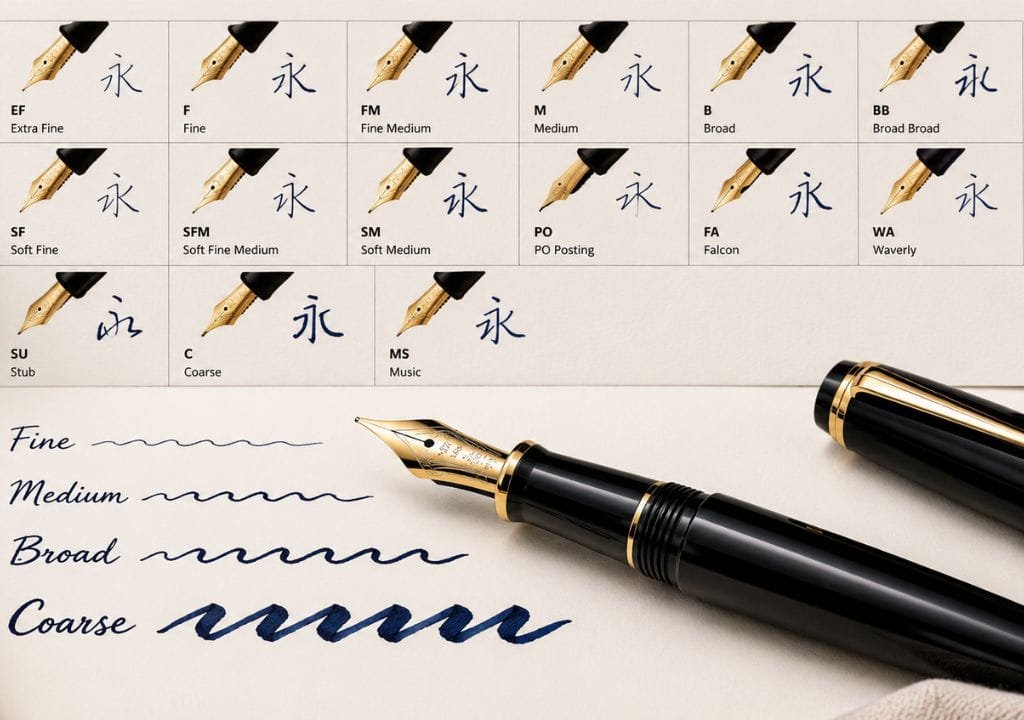
Before picking a nib, it helps to see the whole family side by side. Pilot offers the Custom 742 with a genuinely wide range of nib options — Pilot’s official information puts the total at 15–16 specialised 14K nib types, spanning traditional widths, soft/semi-flexible variants, and specialty grinds for calligraphy-style writing.
The chart below shows how each nib type is labelled and what a stroke from each one looks like, using the same test character for comparison.
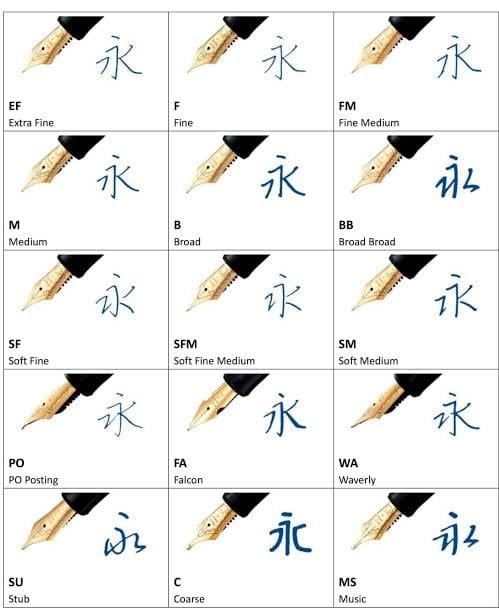
Looking at the chart, you can trace a rough progression from top-left to bottom-right: line width generally increases as you move down the traditional row (EF → F → FM → M → B → BB), while the bottom row introduces specialty shapes — Stub, Coarse and Music — that behave differently from a simple width increase. The Coarse (C) nib, third from left in the bottom row, is visibly one of the widest, boldest strokes in the entire chart, second only to the Music nib in ink laydown.
This is the section worth bookmarking if you’re trying to decide between two specific nibs — scroll back to it as you read the descriptions below.
Pilot Custom 742 Nib Types Explained
Here’s what each of Pilot’s nib options actually does, based on Pilot’s own nib naming and widely corroborated fountain pen community experience.
EFExtra Fine
The finest standard nib Pilot offers. Produces a thin, precise line well suited to dense writing, small handwriting, and forms or planners with limited space.
FFine
A step up from EF. Still precise, but slightly more ink flow, making it a common choice for everyday note-taking and journaling in smaller handwriting.
FMFine Medium
A Pilot-specific width that sits between Fine and Medium. A popular “do everything” choice for people who find Fine too dry and Medium slightly too bold.
MMedium
The most common all-purpose Western nib width. Balances legibility with a visible, satisfying line — a safe default for most first-time fountain pen buyers.
BBroad
A noticeably wider line than Medium, with more ink on the page. Good for people who write in larger letters or want their fountain pen ink’s colour and shading to show clearly.
BBBroad Broad (Double Broad)
Wider again than Broad. At this width, ink properties like sheen and shading become very pronounced, but small or dense handwriting becomes harder to read.
SFSoft Fine
A Fine-width nib with some built-in softness, giving slight line variation under pressure without being a full flex nib.
SFMSoft Fine Medium
The soft counterpart to FM — a fine-medium width with gentle give, offering subtle line variation for expressive but still controlled writing.
SMSoft Medium
A Medium-width nib with softness built in. Offers noticeable line variation for people who want some flex character without the learning curve of a true flex nib.
POPosting
A downturned tip designed for extra-fine, controlled writing, historically associated with posting (writing on the back of postcards) and other very fine, deliberate lettering.
FAFalcon
A semi-flexible nib with a distinctive upward curve. Genuinely responsive to pressure, capable of significant line variation, and popular with people interested in modern-flex or copperplate-adjacent styles. It has a learning curve and is easy to overflex if you’re not used to soft nibs.
WAWaverly
An upturned tip, similar in spirit to the FA but generally milder. Designed to write smoothly at a range of hand angles, including for writers who hold their pen more upright or at an unusual angle.
SUStub
A nib ground with a wider edge, producing line variation between vertical and horizontal strokes — thicker downstrokes, thinner crossbars — for a calligraphy-influenced look without needing an italic script.
CCoarse
Pilot’s designation for an extra-broad, bold-writing nib, positioned by Pilot for large lettering and signatures. Covered in detail above.
MSMusic
Designed originally for musical notation, with two slits in the nib for very high ink flow. It behaves like a stub with even more line variation and ink laydown, and is popular with people who want maximum shading and sheen from their ink.
Coarse vs Broad vs Medium vs Fine
| Nib | Line Character | Best For | Writing Style | Recommended For |
|---|---|---|---|---|
| Fine (F) | Thin, precise, controlled | Dense notes, small handwriting, forms | Careful, compact writers | Students, planners, everyday note-taking |
| Medium (M) | Balanced, visible, all-purpose | General everyday writing | Most handwriting styles | First fountain pen, daily use |
| Broad (B) | Bold, generous ink laydown | Larger handwriting, showing off ink shading | Looser, larger letterforms | Ink enthusiasts, expressive writers |
| Coarse (C) | Very bold, extra-wide | Large lettering, signatures, statement writing | Big, confident, unhurried strokes | Signatures, headers, journaling accents |
A simple way to think about it: Fine and Medium are built for writing, in the sense of getting words down efficiently. Broad and Coarse are built more for expression — they make your ink and your handwriting more visually prominent, at some cost to compactness and drying speed.
Which Pilot Custom 742 Nib Should You Choose?
Choose EF or F. Anything broader will cause letters to merge and lose legibility at small sizes.
Choose M or FM. These give a satisfying line without being so wet that you’re constantly waiting for ink to dry mid-sentence.
Choose B or C. If your natural letters are already large, a fine nib will look thin and scratchy by comparison; a broader nib matches your hand.
Choose C (Coarse) or B. Pilot specifically positions the Coarse nib for bold, large lettering, which lines up well with how most people sign their name — a handful of large strokes rather than dense small text.
Choose FM, M or SM if you want a touch of line variation for a more personal look in a journal without sacrificing legibility.
Choose SU, MS or FA for line variation that adds character.
Choose SU (Stub) for a controlled italic-style contrast, or FA (Falcon) if you want a semi-flexible nib and are willing to practice controlling it.
Choose F or M. These dry fastest and are least likely to smudge under a hand moving across the page.
Is the Pilot Custom 742 Coarse Nib Good for Signatures?
This is one of the most common questions about this nib, and the short answer — based on how Pilot itself positions the Coarse nib — is yes, with a caveat.
Pilot’s own nib description points to the Coarse nib as suited for large letters and signatures, which fits the physical reality of how the nib behaves: a bold, wide, confident line that suits the handful of large strokes most signatures are made of. If your signature is compact or looped tightly, though, a Coarse nib can cause strokes to bleed into each other, which is worth testing (or at least visualising) before you commit.
If you sign documents that also require any surrounding text — forms, contracts — you may prefer to keep a Coarse-nibbed pen dedicated to the signature line only, and use a separate finer pen for the rest of the writing.
Is the Pilot Custom 742 Coarse Nib Good for Everyday Writing?
For most people writing standard paragraph-length notes, the Coarse nib is not the ideal everyday choice. Its main limitation for daily use is simply width: at this line thickness, sentence-length writing takes up considerably more space, dries more slowly, and can look cluttered at typical handwriting sizes.
That said, “everyday” means different things to different people. If your daily writing is large-format — headers, bullet points, big-picture notes, bujo-style spreads, or you simply have large handwriting — the Coarse nib can absolutely work as a daily driver. It’s a matter of matching the nib to your actual handwriting size and pace, not a hard rule against daily use.
Pilot Custom 742 Writing Experience
Pilot’s #10 gold nibs, across the Custom 742 range, are generally known in the fountain pen community for smooth, reliable performance straight out of the box, without the tine-adjustment many other brands’ fine nibs sometimes need. We can’t report first-hand testing results for this specific unit, but this consistency is a widely cited reason the Custom 742 has built a loyal following, independent of which specific nib width you choose.
What does vary meaningfully from nib to nib is feel: fine nibs feel firmer and more precise on the page; broad and coarse nibs feel softer and glide more, simply because more of the tipping material is in contact with the paper at once. Soft nibs (SF, SFM, SM) and the Falcon (FA) add a spring-like give that firmer nibs don’t have. None of this should be read as a claim about how any individual pen will perform — nib feel has some natural unit-to-unit variation, as with any handmade gold nib.
Ink and Paper Recommendations for Broad and Coarse Nibs
Broader nibs put more ink on the page per stroke, which changes what you should look for in ink and paper.
Paper quality matters more with wider nibs. A Coarse or Broad nib lays down enough ink that thin, low-GSM paper (common in cheap notebooks and some printer paper) is more likely to show:
- ● Feathering — ink spreading into fine, hair-like lines along the edge of a stroke, caused by paper fibres wicking ink outward.
- ● Bleed-through — ink soaking through to the back of the page, making the reverse side unusable.
- ● Slow drying — more ink per stroke naturally takes longer to dry, increasing smudge risk if you’re a left-handed writer or write quickly.
Fountain-pen-friendly paper (generally 90gsm+, coated or well-sized) handles broader nibs far better, showing ink shading and sheen clearly without feathering.
Ink choice. With a Coarse or Broad nib, well-behaved, moderately saturated fountain pen inks tend to show off shading nicely without becoming difficult to control. Very high-saturation or heavily shimmering inks can look spectacular in a broad nib but may need a bit more care with flow and cleaning. This is general fountain pen guidance rather than a product-specific recommendation, and personal ink preference plays a large role here.
How to Care for a Pilot Custom 742 Fountain Pen
- ● Flush the pen regularly. When changing ink colours, or every few weeks with heavy use, flush the nib and feed with clean water until it runs clear.
- ● Avoid drying out. Cap the pen fully when not in use, and if it will sit unused for more than a few weeks, consider flushing and storing it dry.
- ● Store nib-up or flat, not nib-down for long periods, to reduce the chance of ink pooling or drying unevenly in the feed.
- ● Handle the tines gently, especially with soft (SF/SFM/SM) or Falcon (FA) nibs — these are designed to flex slightly, but excessive pressure can spring them permanently.
- ● Use compatible refills. The Custom 742 takes Pilot proprietary cartridges or a compatible converter such as the CON-70N; using a converter designed for a different brand’s pen is not recommended.
Pilot Custom 742 vs Other Pilot Fountain Pens
- ● Custom 742 vs Custom 74 — The Custom 74 uses a smaller #5 nib and generally has a narrower range of specialty nib options than the 742’s #10 nib range. The 742 is the larger, heavier pen of the two.
- ● Custom 742 vs Custom 743 — The 743 is a larger pen built around a #15 nib, offering a bigger grip and body, while the 742 is slightly thinner and lighter with the same #10 nib philosophy.
- ● Custom 742 vs Custom 823 — The 823 is a vacuum-filler pen with a piston-style mechanism and a much larger ink capacity than the cartridge/converter 742, aimed more at people who prioritise ink volume and a see-through barrel over cartridge convenience.
We’ve limited this comparison to points that are consistently and reliably documented rather than speculating on subtleties that would need hands-on testing of each individual pen. See other Pilot pens available at The Pen Lounge.
Who Should Buy the Pilot Custom 742 Coarse?
The Coarse nib makes the most sense for:
- ● People with naturally large handwriting who find Medium and Broad nibs still feel a little thin.
- ● People who want a dedicated pen for signing documents, letters, or artwork.
- ● Ink enthusiasts who want to see shading and sheen properties at their most visible.
- ● Journalers or note-takers who write in large, loose script rather than dense small text.
It’s a less natural fit for people with small or tightly-spaced handwriting, or anyone who needs their fountain pen writing to dry quickly for practical reasons (left-handed writers in particular may want to test broader nibs carefully).
Where to Buy Pilot Custom 742 in India
The Pilot Custom 742 — including the Black with Coarse (C) Nib configuration (FKK-2000R-B-C) — is available in India through The Pen Lounge, alongside a wider range of premium Pilot fountain pens, inks, notebooks and other writing instruments.
If you’re considering the Coarse nib after reading this guide, it’s worth browsing the rest of the Pilot range and Pilot-compatible inks on the site to plan your full writing setup, from converter to paper. New to fountain pens? Start with our beginner’s guide to fountain pens. Learn more About The Pen Lounge.
Frequently Asked Questions
What is a Pilot Custom 742 Coarse nib?
It’s one of Pilot’s extra-broad 14K gold nib options for the Custom 742, positioned by Pilot for bold lettering, large handwriting and signatures.
Is Pilot Custom 742 a good fountain pen?
It’s a well-regarded pen in the fountain pen community, primarily because of its wide nib selection and #10 gold nib, and its cartridge/converter system with support for the high-capacity CON-70N converter.
Is the Pilot Custom 742 Coarse nib good for signatures?
Yes — Pilot’s own nib guidance points to the Coarse nib as suited to large letters and signatures, and its bold, wide line matches how most signatures are written.
Is a Coarse nib broader than a Broad nib?
Yes. In Pilot’s line-up, Coarse (C) sits above both Broad (B) and Double Broad (BB) in terms of overall line width.
What is the difference between Pilot C and B nib?
Both are bold, wide nibs, but the Coarse (C) nib lays down an even wider, bolder line than Broad (B), making it better suited to large lettering and less suited to compact daily writing.
Which Pilot Custom 742 nib is best for beginners?
Medium (M) or Fine Medium (FM) are the most commonly recommended starting points — wide enough to show off fountain pen ink, narrow enough for everyday legibility.
Which Pilot nib is best for small handwriting?
Extra Fine (EF) or Fine (F), since these keep strokes thin enough to stay legible at small sizes.
Which Pilot nib is best for large handwriting?
Broad (B) or Coarse (C), which match a bigger, looser hand without looking thin or scratchy.
What is a Pilot FA nib?
The Falcon — a semi-flexible nib with an upturned tip, capable of noticeable line variation under pressure, aimed at writers interested in a modern-flex writing style.
What is a Pilot PO nib?
The Posting nib — a downturned tip designed for very fine, controlled writing, historically used for writing on postcards.
What is a Pilot WA nib?
The Waverly — an upturned nib designed to write smoothly across a range of hand angles, milder than the Falcon.
What is a Pilot SU nib?
The Stub — a nib ground to produce line variation between vertical and horizontal strokes, giving a calligraphy-influenced look.
What is a Pilot MS nib?
The Music nib — originally designed for musical notation, with two slits for very high ink flow, producing a bold, expressive line similar to a stub with more ink.
Does Pilot Custom 742 use a gold nib?
Yes. It uses a 14K gold No. 10 nib across all of its available nib type options.
What converter does Pilot Custom 742 use?
It’s compatible with Pilot converters including the CON-70N, as well as Pilot’s proprietary ink cartridges.
Where can I buy Pilot Custom 742 in India?
Through The Pen Lounge (thepenlounge.com), which carries the Custom 742 along with other premium fountain pens, inks and stationery.
This guide is based on Pilot’s official nib descriptions and widely corroborated fountain pen community knowledge. Personal handwriting size, pressure and paper choice will affect how any nib performs in practice — when possible, try writing samples before committing to a specific width.