
Blog
The Complete Guide to Fountain Pen Filling Systems: Cartridges, Converters & Beyond

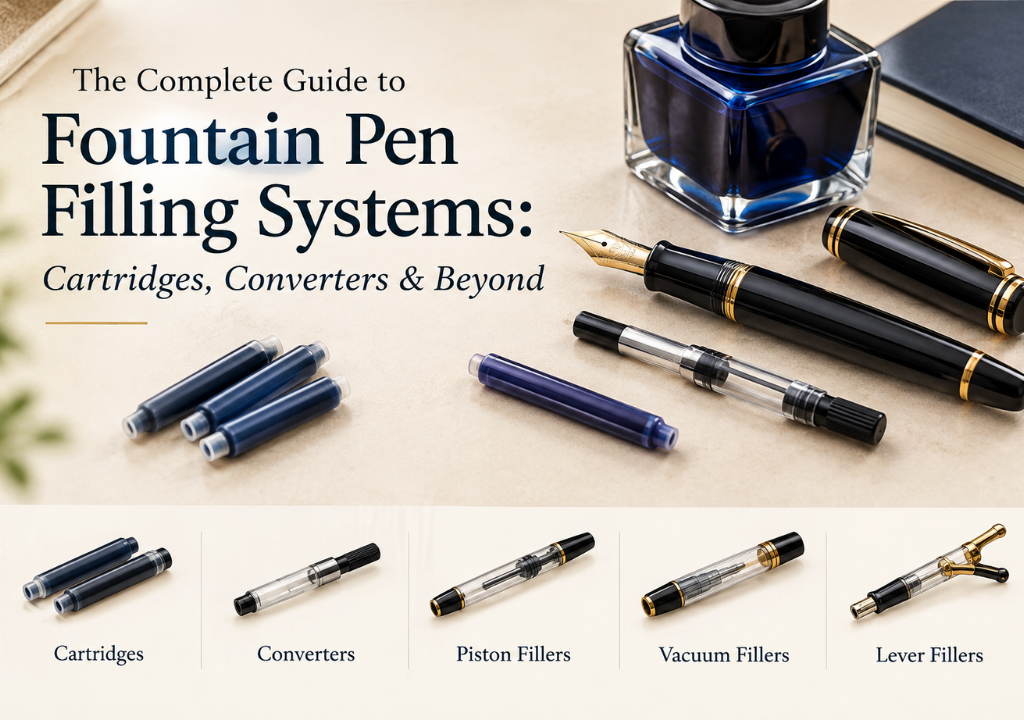
The Complete Guide to Fountain Pen Filling Systems: Cartridges, Converters & Beyond
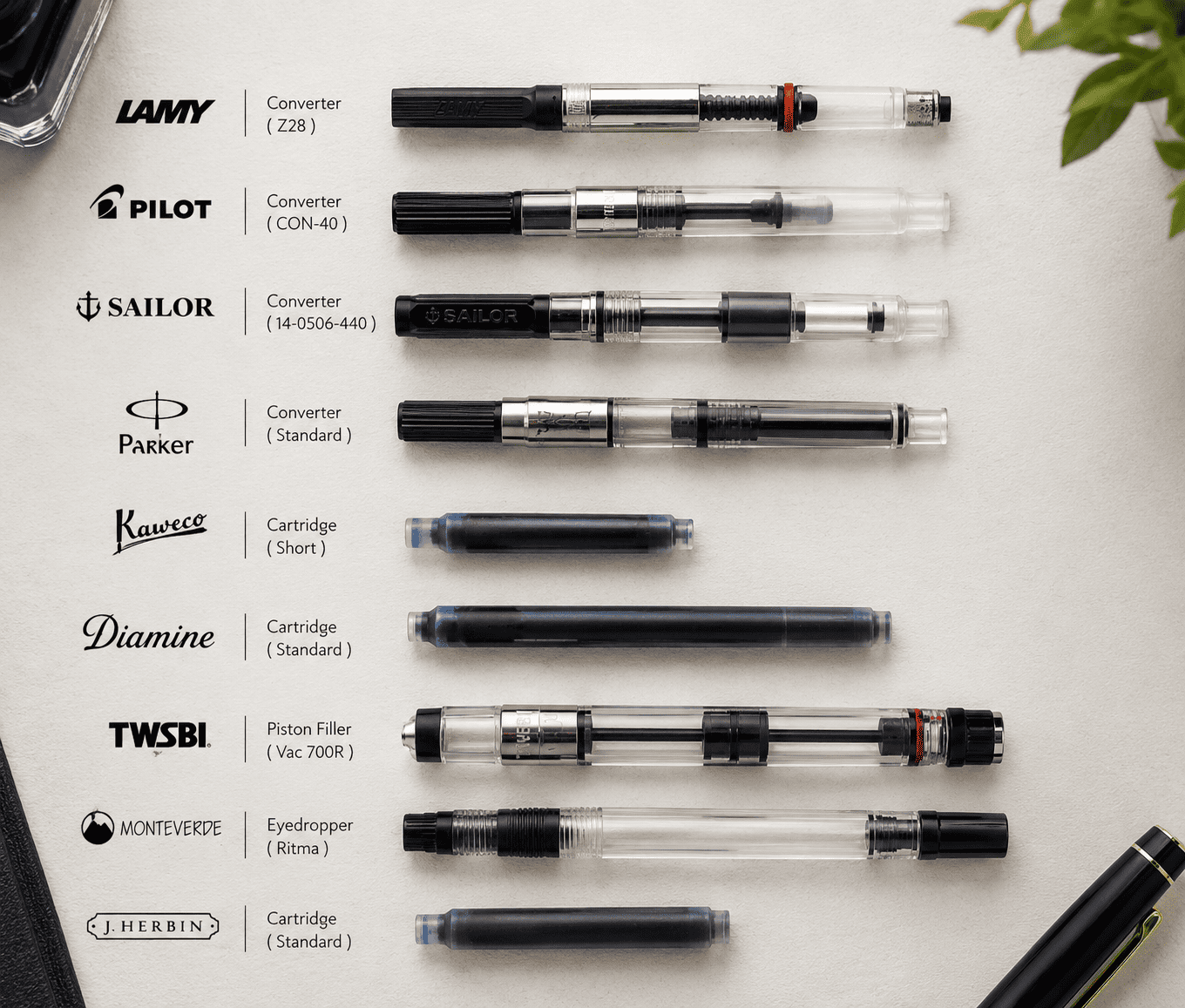 flat-lay of different pen filling mechanisms side by side
Most articles online only compare cartridges vs. converters and stop there. But that barely scratches the surface. Fountain pens have used over half a dozen distinct ink filling systems throughout their history, and understanding all of them helps you choose a pen that actually fits how you write — not just what’s easiest to find in a store. This guide covers every major fountain pen filling mechanism, how each one works, and which one is right for you.
Why the Filling System Matters More Than You Think
Most beginners focus on nib size or pen body material when choosing a fountain pen, but the filling system affects your day-to-day experience just as much:
- How much ink capacity you get per fill
- How many ink colors you can realistically own and switch between
- How messy or clean the refilling process is
- Whether you can use bottled ink at all, or only proprietary cartridges
1. Cartridge Filling System
The simplest, most beginner-friendly option
A pre-filled tube of ink is inserted into the pen’s grip section and punctured internally.
- Extremely convenient — no mess, no tools
- Easy to carry spares while traveling
- Great for beginners learning how to use a fountain pen
- Limited to manufacturer’s cartridge ink colors
- Generally not reusable
- Often pricier per milliliter than bottled ink
For a full step-by-step walkthrough, see our guide on how to install ink cartridges.
 fountain pen ink cartridge being inserted into grip section
2. Converter Filling System
Reusable, bottled-ink-compatible
A converter is a small reusable device that replaces a cartridge, letting you draw ink from a bottle instead. It usually screws into the same slot a cartridge would use, using either a twist/piston mechanism or a squeeze mechanism.
- Opens up thousands of bottled ink colors
- Reusable indefinitely
- Cheaper per fill long-term
- Lower ink capacity than most refillable systems
- Requires carrying a bottle to refill on the go
- Not every pen is converter-compatible
 converter being twisted to draw ink from a bottle
3. Piston Filling System
Higher capacity, built into the pen itself
Common in higher-end fountain pens, a piston filler has a built-in mechanism inside the barrel — no cartridge or converter needed. Twisting the end of the pen moves an internal piston that draws ink directly in.
- Very high ink capacity — often 2-3x a converter
- No small parts to lose
- Seen as a mark of higher build quality
- Pen must be partially submerged to fill
- Usually found only in mid-to-high price ranges
- Harder to fully clean between ink colors
 piston filler mechanism at the end of the pen barrel
4. Vacuum Filling System
Enthusiast favorite for maximum capacity
A vacuum filler uses a plunger mechanism to create suction, pulling a large volume of ink into the barrel in one motion.
- Extremely high capacity — nearly double a piston filler
- Efficient, satisfying single-stroke fill
- More complex mechanism, costlier repairs
- Fewer pen models available
 vacuum filler plunger mechanism in action
5. Lever & Aerometric Filling Systems (Vintage-Style)
Classic mechanism, still found in reproductions
Dominant in vintage fountain pens. A lever on the barrel compresses an internal ink sac; releasing it creates suction that draws ink in.
- Nostalgic mechanism sought by collectors
- Reasonably good ink capacity
- Ink sacs degrade and may need replacing
- Repairs often require a specialist
6. Eyedropper Filling System
Maximum capacity, minimum cost
The entire pen barrel acts as the ink reservoir, filled directly using an eyedropper or syringe — no internal mechanism at all.
- Massive ink capacity — the whole barrel is the tank
- Works with almost any compatible pen
- Cheapest system — no mechanical part to manufacture
- Higher risk of leaking or “burping” if not sealed with silicone grease
- Requires more careful handling
Comparison Table: Which Filling System Should You Choose?
| Filling System | Ink Capacity | Best For | Bottled Ink Compatible? |
|---|---|---|---|
| Cartridge | Low | Absolute beginners, travel | No (proprietary only) |
| Converter | Low-Medium | Beginners wanting bottled ink variety | Yes |
| Piston | High | Daily writers, enthusiasts | Yes |
| Vacuum | Very High | Heavy writers, journalers | Yes |
| Lever/Aerometric | Medium | Vintage pen collectors | Yes |
| Eyedropper | Very High | Budget-conscious, high-volume users | Yes |
How to Choose the Right Filling System for You
- New to fountain pens? Start with a cartridge-converter pen — it gives you flexibility to try both systems in one pen.
- Want variety in ink colors? Prioritize converter, piston, or eyedropper pens that accept bottled ink.
- Write a lot daily? A piston or vacuum filler saves you from refilling constantly.
- On a budget but want high capacity? An eyedropper-converted pen offers the best ink-per-dollar ratio.
Frequently Asked Questions
Not always — it depends on whether the manufacturer sells a compatible converter. Some proprietary cartridge systems have no converter option at all.
Cartridge and converter systems are generally easiest since fewer internal parts hold onto old ink residue.
If you write daily and want higher ink capacity with fewer refills, yes — many enthusiasts consider it a worthwhile long-term investment.
Many demonstrator (clear-barrel) pens can be converted with silicone grease to prevent leaking, but not all pen designs are suitable — check compatibility first.
For a deeper technical breakdown of fountain pen mechanics in general, see Wikipedia’s overview of the fountain pen.
Ready to find your perfect fill system? Browse our full range of cartridge, converter, and piston-fill fountain pens.