Blog
How to identify a fake vs real fountain pen

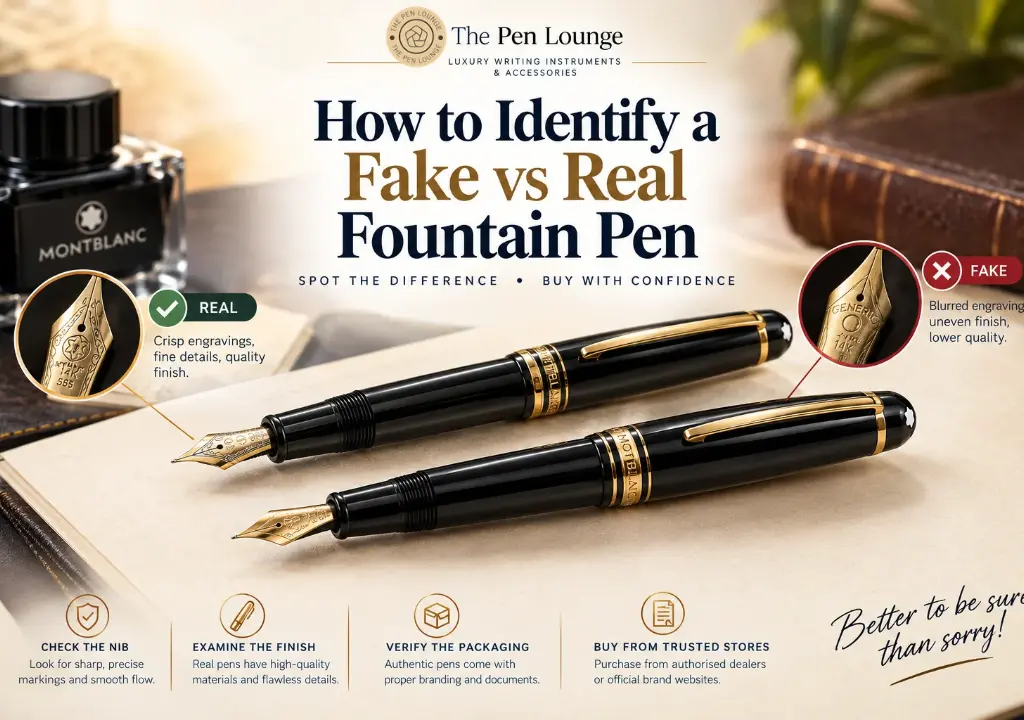
How to Identify a Fake vs Real Fountain Pen: 10-Point Checklist
Worried a pen might be counterfeit? Use this 10-point checklist to tell a real fountain pen from a fake before you buy or sell a pre-owned pen.
Quick answer: no single test proves a pen is real. To identify a fake fountain pen, combine several checks: a fair price, crisp engraving, correct nib markings, a quality finish, a smooth writing test and a seller who answers questions. If more than one check fails, walk away.
Why fake pens fool so many buyers
Popular brands such as Montblanc, Parker and Waterman are copied because people recognise them. Small photos hide poor finishing, and on second hand pen sites and in private groups nobody inspects the pen before it changes hands. Collectors also point out that the market for pre-owned pens in India is mostly unorganised, so buyers often have to judge a seller by reputation alone.
The good news: most fakes show their weak spots when you look at specific details. Use the checklist below.
The 10-point checklist: real vs fake fountain pen
- 1. Compare the price. Look at several similar pens that are for sale. A big gap is a warning, not a bargain.
- 2. Feel the weight and balance. Genuine pens usually feel solid and balanced for their model. Very light or oddly weighted pens deserve a closer look. Compare with the brand’s listed specs.
- 3. Inspect the engraving. Brand names, logos and lettering should be sharp, even and correctly spelt. Blurry, shallow or crooked engraving is a red flag.
- 4. Read the nib markings. Look for the brand, the material (such as 14K or 18K) and the size. Markings should be clean and consistent. Fake nibs often carry gold-looking marks on plain steel.
- 5. Test the cap and clip. A real cap closes with a firm, precise fit. The clip should be well finished and spring back properly.
- 6. Check the finish and seams. Look for glue marks, rough threads, uneven gaps and loose parts. Quality brands finish these areas carefully.
- 7. Look at serial numbers and hallmarks. Many brands engrave a serial or hallmark. Missing or mismatched marks are a concern, but a serial number alone proves nothing because fakes copy them.
- 8. Try the filling system. Pistons and converters should work smoothly and hold ink without leaking.
- 9. Treat the box and papers carefully. Original packaging is a plus, but boxes can be swapped or faked. Check print quality and fonts, and never rely on the box alone.
- 10. Do a writing test. A genuine pen writes smoothly with steady flow. Scratchy, dry or flooding writing can signal a poor copy or a damaged nib.
Genuine vs fake at a glance
| Check | Usually genuine | Possible red flag |
|---|---|---|
| Engraving | Sharp, even, correct spelling | Blurry, shallow or crooked |
| Nib | Clean markings, even tipping | Plain steel with gold-looking marks |
| Cap fit | Firm, precise close | Loose or rough fit |
| Finish | Smooth seams, clean threads | Glue marks, gaps, rough edges |
| Writing | Smooth and steady | Scratchy, dry or flooding |
| Listing | Original photos, clear answers | Stock photos, vague replies |
You may read that a magnet can reveal a fake nib. It is not reliable: real gold is not magnetic, but many steel nibs are non-magnetic too, so a pass proves nothing.
Replace this box with your own story before publishing. Real, specific experience builds trust with readers and with Google.
Add a real story here. Examples: a fake you spotted and what gave it away, a pen that looked suspicious but turned out genuine, or a customer who nearly paid too much. Say the model, what you checked and what you learned.
Red flags in a pen listing
- Only stock photos. A genuine seller can photograph the actual pen.
- Refusal to send more photos or a writing video. Honest sellers do not mind.
- Pressure to pay quickly. Urgency is a classic scam tactic.
- A price far below the market. Ask yourself what the seller knows that you do not.
- Vague claims like “100% original”. Look for details: model, nib, serial, condition, what is included.
What to do if you are not sure
Ask for close-ups of the nib, cap band, clip and any serial number. Compare them with official photos on the brand’s website. Ask an experienced collector to look at your photos. For expensive pens, the brand’s service centre or an authorised dealer may be able to help. If the seller will not cooperate, do not buy.
How The Pen Lounge handles authenticity
We have a zero-tolerance policy for counterfeits and replicas, including “homage” pens that copy trademarked designs too closely. Sellers guarantee that their pen is genuine. When a pen reaches us, we check it against the seller’s photos. If it does not match, we reject the order, refund the buyer and no payout is made.
Got a genuine pen to sell? List it with us.
How to Identify a Fake vs Real Fountain Pen: FAQs
How can I tell if a Montblanc pen is real?
Combine several checks: price, engraving quality, nib markings, finish, a writing test and serial or hallmark details compared with official photos. No single sign is enough, so ask a collector or the brand’s service centre when unsure.
Does a magnet show if a nib is fake?
No. The test is unreliable because many genuine and fake nibs are non-magnetic. Use it only as a minor clue.
Is a serial number enough to prove a pen is genuine?
No. Fakes can copy serial numbers. Treat it as one clue and compare it with other details.
Does a missing box mean the pen is fake?
No. Many genuine pre-owned pens come without a box. A box also does not prove a pen is real, because boxes can be swapped or faked.
What should I do if I bought a fake pen?
Contact the seller and the platform you paid through, keep all messages and receipts, and ask for a refund. Report the listing if the platform allows it.
Can I sell a pen without papers?
Yes, as long as it is genuine. Photograph it clearly and describe what is included. Papers and a box help but are not required.