Blog
The History of Pens: From Ancient Writing Tools to Modern Pens

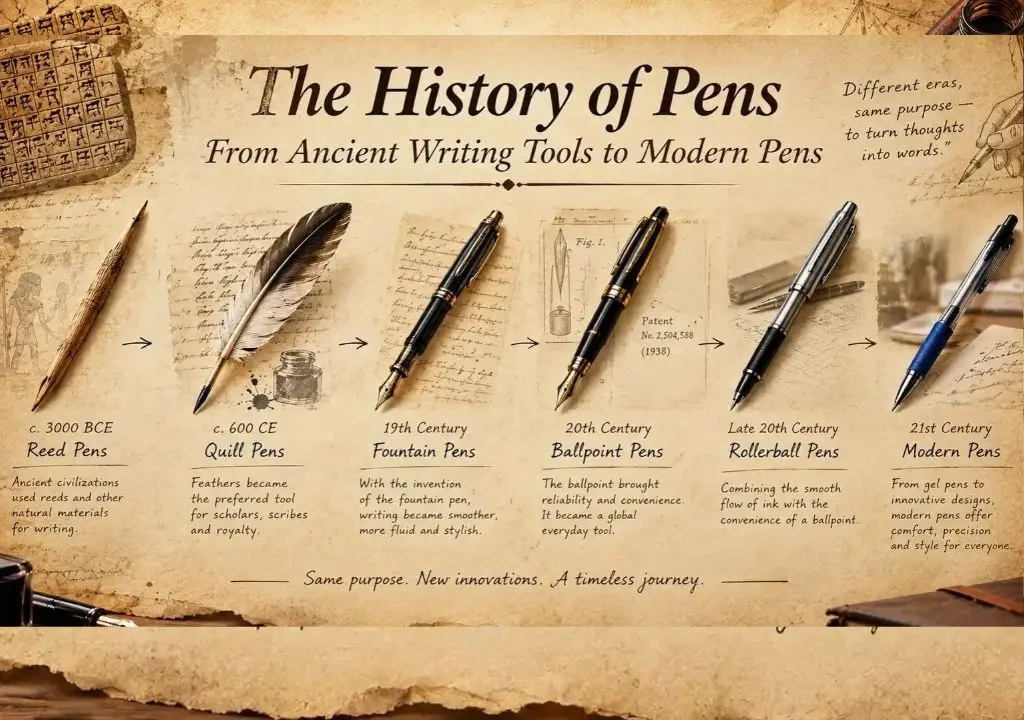
The history of pens is the story of how people learned to make thoughts last. The pen in your hand today has roots in the Nile Valley, in medieval scriptoriums, in Birmingham workshops and even in wartime aircraft. It was never invented in a single moment. It was refined over thousands of years.
Today we have fountain pens, ballpoints, rollerballs, gels and hand-finished luxury instruments. Each one solved a problem left behind by the one before it. Once you know that story, you start to notice the nib, the ink flow and the balance of whatever pen you pick up.
In short
- No single person invented the pen. Reed pens, quills, steel nibs, fountain pens and ballpoints each built on earlier ideas.
- Every new pen type fixed a specific problem: dipping, wear, leaking or maintenance.
- Modern luxury pens turn that long engineering story into craft, materials and personal expression.
In this guide
- What people used before pens
- The ancient reed pen
- The quill pen
- The development of metal nibs
- The birth of the fountain pen
- How fountain pens changed writing
- The golden age of fountain pens
- The ballpoint pen revolution
- The rise of rollerball pens
- The modern pen
- The evolution of the luxury pen
- Pen history timeline
- Pen types at a glance
- Frequently asked questions
What Did People Use Before Pens?
Long before anyone dipped a pen in ink, people were already making marks. Prehistoric cave paintings were made with mineral pigments such as ochre and charcoal, applied with fingers, hollow bones, moss or simple brushes.
Writing itself came later. In Mesopotamia, around 3300 to 3000 BCE, scribes pressed a cut reed stylus into soft clay tablets to form wedge-shaped cuneiform. That stylus carried no ink. It impressed marks into clay.
Other early tools included:
- Brushes made from plant fibre or animal hair, used with carbon-based ink in Egypt and China
- Styluses of bone, metal or reed, used on clay and wax tablets
- Pigments and inks made from soot, gum, ochre and plant extracts
A useful distinction: a writing instrument is any tool that leaves a mark. A pen, in the modern sense, carries ink and deposits it on a surface through a tip. Clay styluses are writing instruments. The first ink-carrying pens came later, which is why there is no single “first pen”.
The Ancient Reed Pen
Ink-carrying writing tools appear alongside papyrus in ancient Egypt. Scribes wrote with cut stems of rush or reed, dipped in ink made from soot or carbon mixed with gum. The ink was kept as small cakes on a scribe’s palette. The scribe wet the tip, rubbed it on the cake and wrote on sheets of papyrus.
Earlier Egyptian rush pens were chewed or cut to a brush-like tip. Reed pens with a cut, split nib became standard in the Greek and Roman periods, and they stayed in use around the Middle East and the Mediterranean for centuries.

How a reed pen works
A reed stem is hollow and naturally rigid. The writer cuts one end to a point and splits it slightly. Ink clings to the tip and the small gap by capillary action, then flows onto the page as the split opens under light pressure.
Reeds were cheap, easy to find and easy to re-cut. The limits were frequent dipping and a tip that wore down quickly.
The Quill Pen
Feather quills appear in written records from around the 6th to 7th century CE and became the dominant European writing tool for roughly a thousand years. Goose feathers were the most common. Swan, turkey and crow feathers were used for particular needs, such as finer lines.
Preparing a quill
- A flight feather was chosen, often from the outer wing.
- The feather was cured, traditionally with heat, to harden the shaft.
- The barbs were trimmed away for grip.
- The tip was cut to a point and slit with a small knife. That job is where the word “penknife” comes from.
The hollow shaft held a small reserve of ink, so a quill wrote for longer than a reed pen. It also allowed finer, more flexible lines. That made it ideal for the detailed hands used by medieval scribes in manuscripts and legal documents.
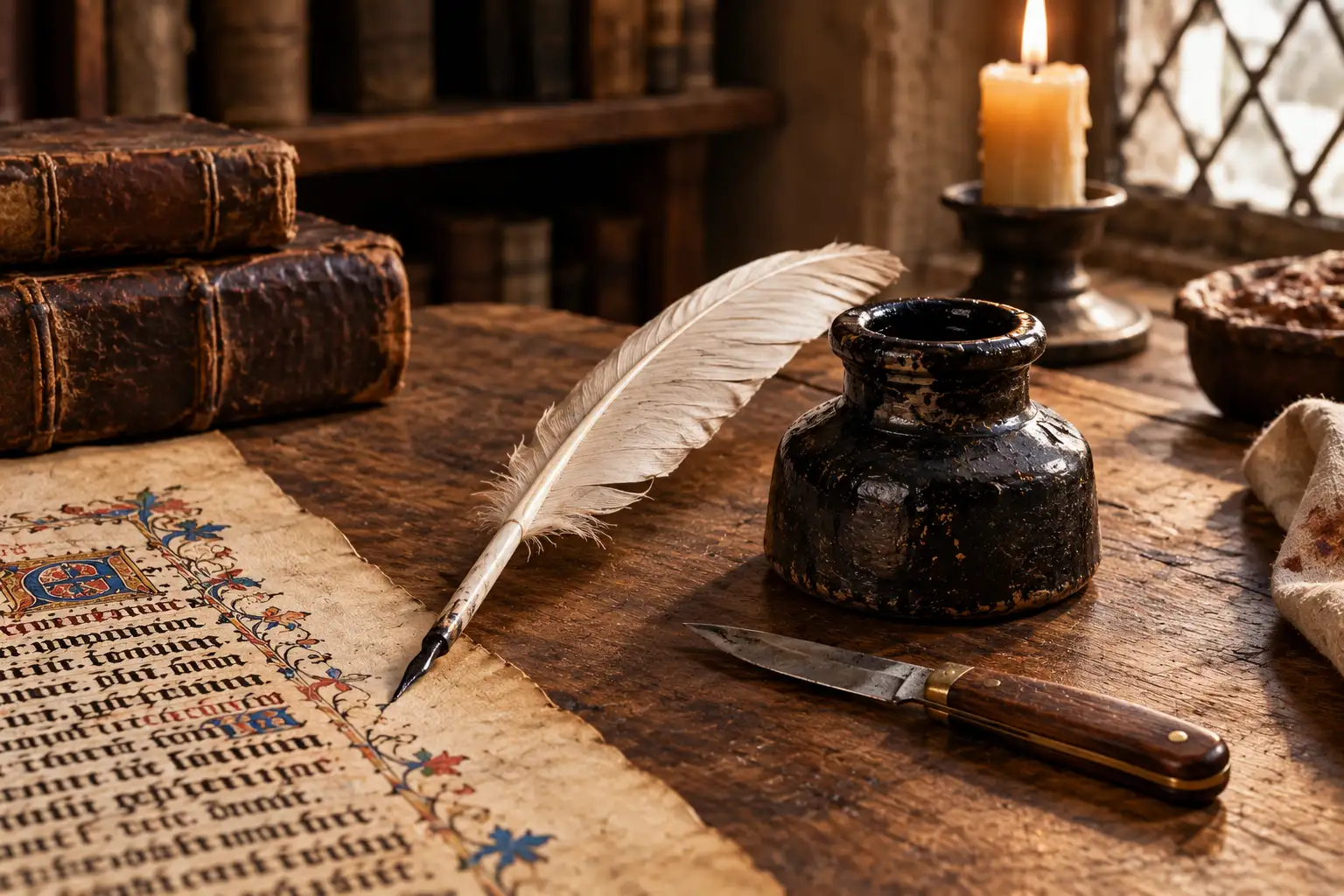
Quills stayed important for so long because they were inexpensive, widely available and well suited to the light pressure of handwriting. Their weaknesses were fast tip wear and constant recutting.
How the quill system works:
- Feather
- Shaft
- Cut nib
- Ink
- Writing surface
The Development of Metal Nibs
Metal writing tips existed in ancient times. Bronze pens have been found in Roman contexts, for example. But they did not become practical for everyday use until much later.
By the late 18th century, makers in England were experimenting with steel pens. The real change came in the 1820s and 1830s, when Birmingham manufacturers such as John Mitchell and Joseph Gillott began producing steel nibs in large numbers using rolling and pressing techniques.
Why people switched:
- Durability: a steel nib lasted far longer than a feather
- Consistency: every nib wrote like the next, which hand-cut quills could never promise
- Lower cost: mass production made nibs cheap enough for schools and offices
- Less preparation: no recutting, curing or trimming
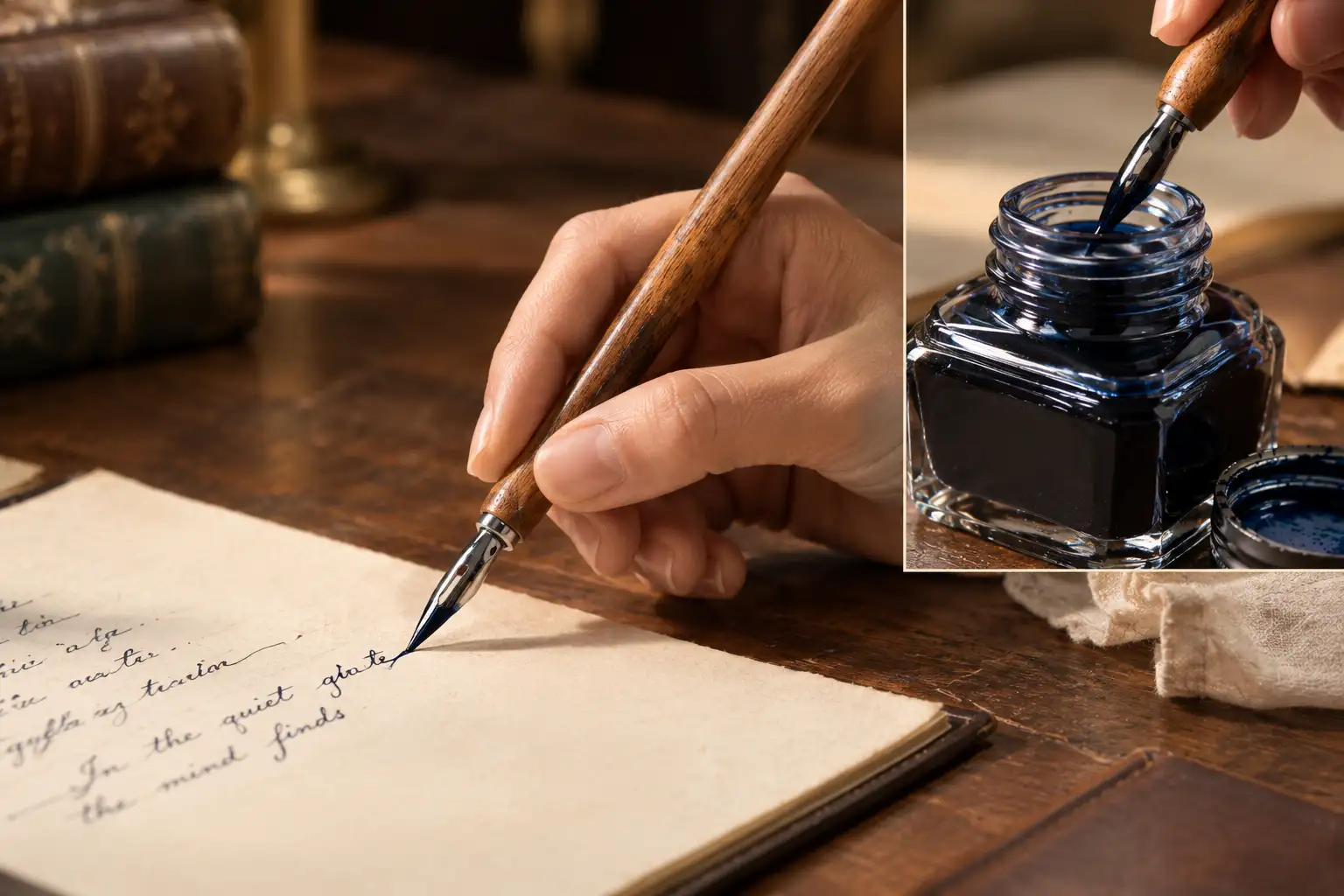
As literacy and commercial writing grew through the 19th century, demand for reliable pens exploded. These dip pens still needed an inkwell, though. Writers wanted a pen that carried its own ink, and that demand led to the fountain pen.
The Birth of the Fountain Pen
The fountain pen has no single inventor. It developed over centuries, through many attempts to build a pen that holds its own ink.
Early ideas
- A 10th-century account from Fatimid Egypt describes a ruler asking for a pen that would not stain his hands, apparently with an ink reservoir.
- In 1636, German writer Daniel Schwenter described a pen made from one quill inside another, with the inner quill acting as an ink reservoir.
- In 1827, Romanian inventor Petrache Poenaru received a French patent for a fountain-style pen that used a quill barrel as the reservoir.
The problems
Early designs struggled with ink that flowed too fast and leaked, or too slowly and dried out. A pen has to let ink out and air in at the same time.
The breakthrough: the feed
In 1884, American insurance salesman Lewis Waterman patented a practical feed that used capillary action and air channels to regulate ink. A popular story says he created it after a leaking pen ruined an important contract. That tale is hard to verify, so treat it as company legend.
Around the same time, George Parker in Wisconsin and others pushed designs forward. Manufacturers turned the idea into a dependable product with proper filling systems, hard rubber barrels and gold nibs.
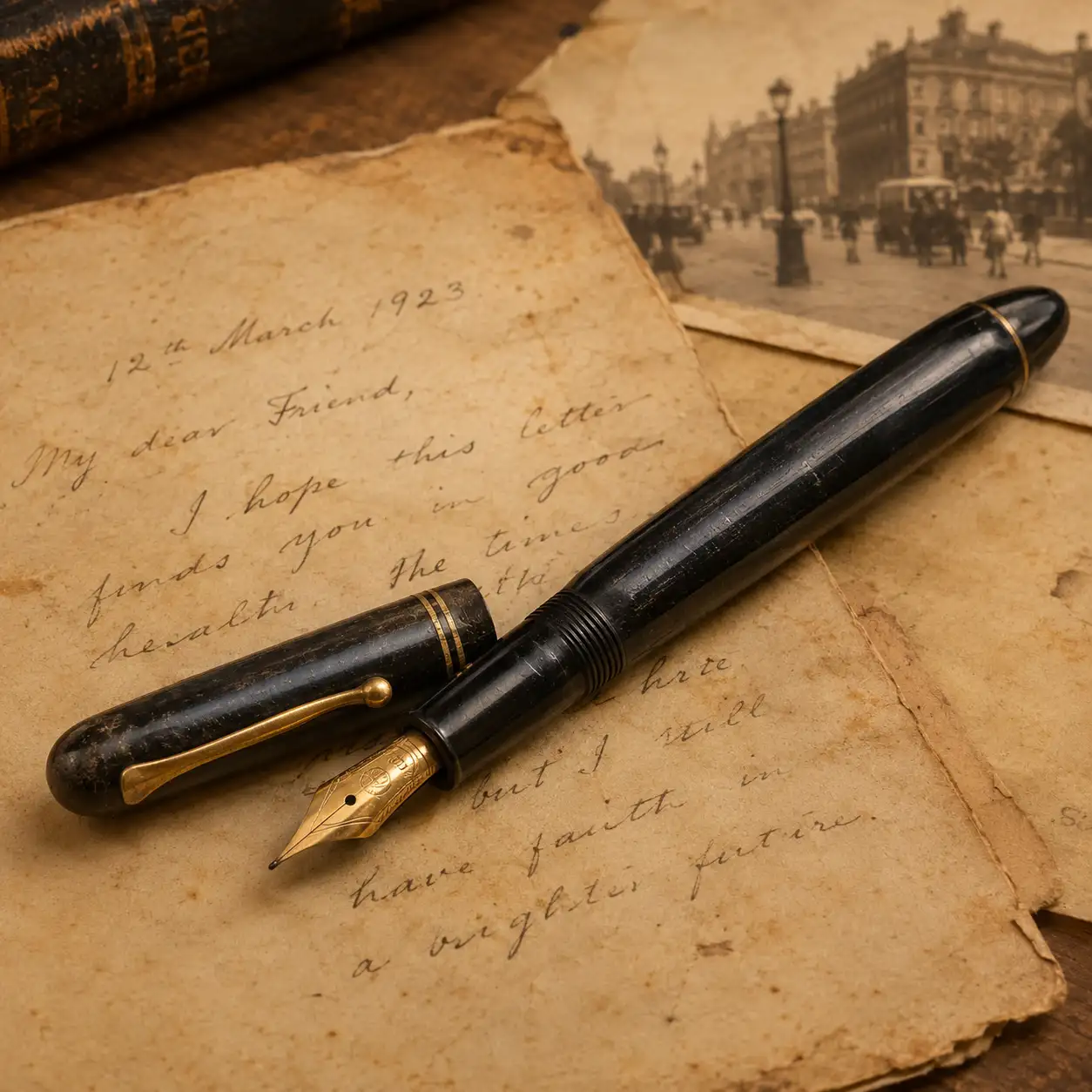
How Fountain Pens Changed Writing
Fountain pens were a real technological step, and the reasons are practical:
- A portable ink supply: no inkwell needed on the desk
- Continuous writing: no stopping to dip every few words
- Nib choice: fine, medium, broad, italic and flexible nibs let writers choose a line
- Comfort: the pen glides with light pressure, which reduces hand fatigue
- Personal handwriting: a nib responds to speed and pressure, so writing looks different from person to person
They changed business, correspondence and note-taking, and they made writing a more personal experience than any dip pen allowed. Explore modern options in our Fountain Pens collection, or find the right ink in Fountain Pen Inks.
The Golden Age of Fountain Pens
From the late 19th century through the 1930s, fountain pens were everyday essentials and status symbols, and manufacturers competed hard.
| Maker | Why it matters |
|---|---|
| Waterman | Popularised a practical feed system in the 1880s |
| Parker | Introduced the Duofold in 1921 and the Parker 51 in 1941 |
| Sheaffer | Known for its lever-filling system, patented in 1908 |
| Wahl-Eversharp | Known for pens and mechanical pencils in the early 20th century |
| Pelikan | Brought the piston filler to a wide audience, with the Pelikan 100 launching in 1929 |
| Montblanc | Founded in Hamburg in 1906, with the Meisterstück launched in 1924 |
Competition drove innovation. Makers developed new filling systems such as levers, pistons and cartridges, new materials such as hard rubber and celluloid, and better nib alloys. Bright, patterned celluloid in particular made pens as pleasing to look at as they were to use.
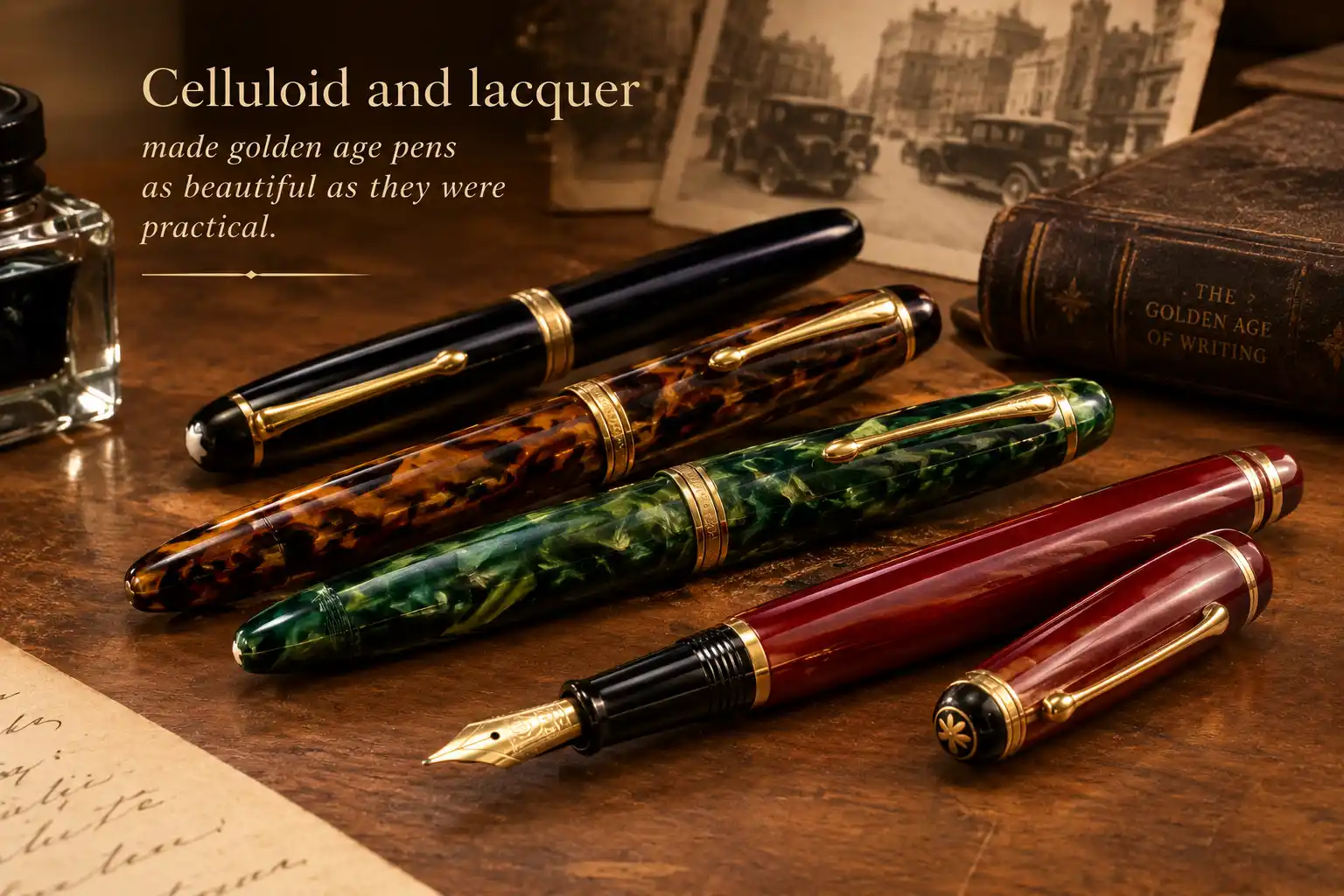
Browse Pen Brands to see how these heritage names continue today.
The Ballpoint Pen Revolution
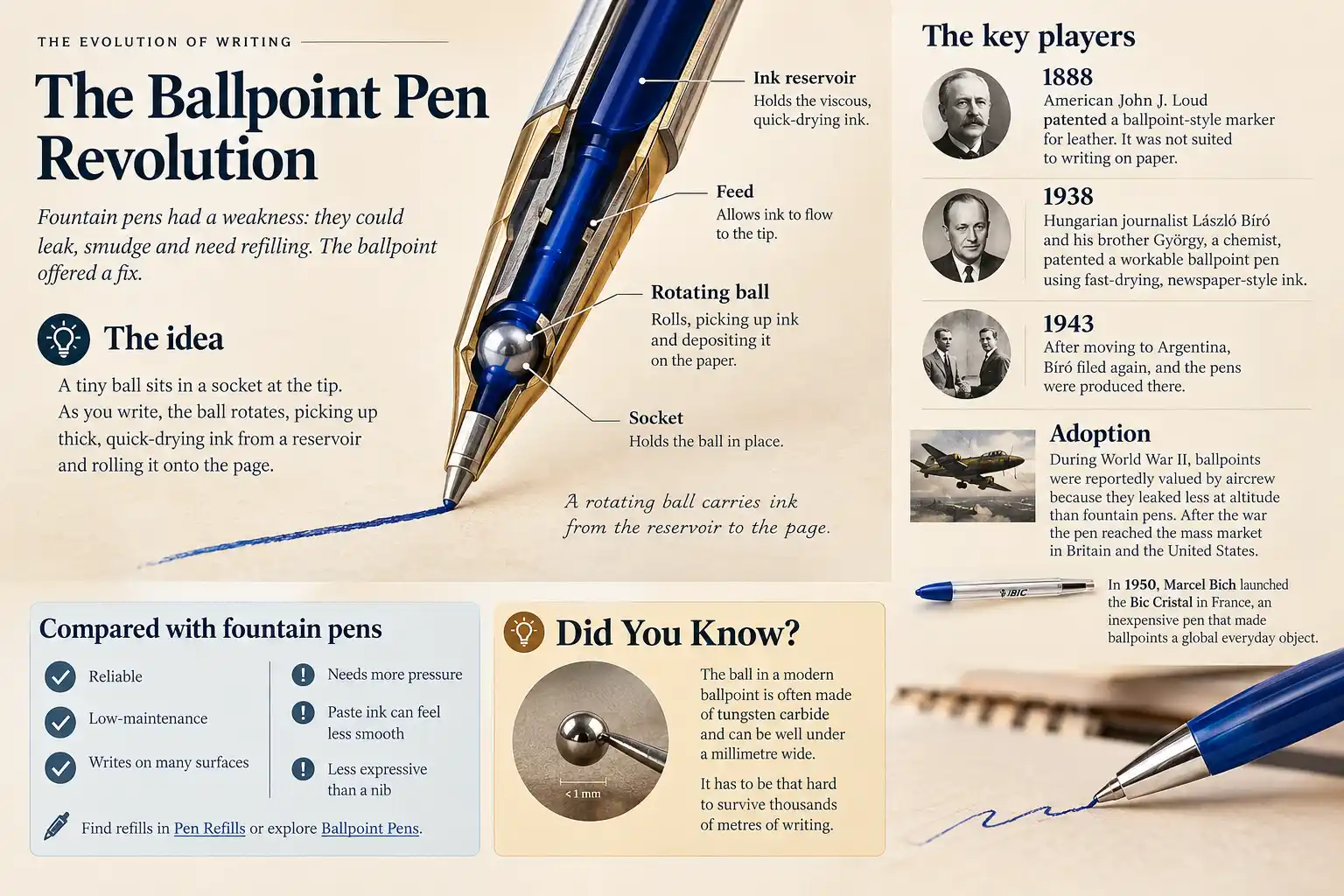
Fountain pens had a weakness: they could leak, smudge and need refilling. The ballpoint offered a fix.
The idea
A tiny ball sits in a socket at the tip. As you write, the ball rotates, picking up thick, quick-drying ink from a reservoir and rolling it onto the page.
The key players
- In 1888, American John J. Loud patented a ballpoint-style marker for leather. It was not suited to writing on paper.
- In 1938, Hungarian journalist László Bíró and his brother György, a chemist, patented a workable ballpoint pen using fast-drying, newspaper-style ink.
- After moving to Argentina, Bíró filed again in 1943, and the pens were produced there.
Adoption
During World War II, ballpoints were reportedly valued by aircrew because they leaked less at altitude than fountain pens. After the war the pen reached the mass market in Britain and the United States. In 1950, Marcel Bich launched the Bic Cristal in France, an inexpensive pen that made ballpoints a global everyday object.
Compared with fountain pens: ballpoints are reliable, low-maintenance and write on many surfaces. But the paste ink needs more pressure, and the writing feel is less expressive than a nib. Find refills in Pen Refills or explore Ballpoint Pens.
The Rise of Rollerball Pens
Rollerball pens combine the rolling-ball tip of a ballpoint with a water-based or gel ink that behaves more like a fountain pen’s. Japan led this development. Ohto introduced the first rollerball in 1963, and gel inks followed in the 1980s, with Sakura’s Gelly Roll launching in 1984.
| Feature | Fountain pen | Ballpoint | Rollerball |
|---|---|---|---|
| Ink type | Liquid, water-based | Thick oil-based paste | Liquid or gel, water-based |
| Writing feel | Expressive, nib-dependent | Firm, pressure-based | Smooth and light |
| Ink flow | Regulated by the feed | Slow and controlled | Fast and generous |
| Smoothness | High | Moderate | Very high |
| Everyday use | Needs some care | Highly convenient | Convenient, but ink may smudge |
Rollerballs suit writers who want smoothness without the upkeep of a nib. Explore our Rollerball Pens.
The Modern Pen
After ballpoints went mainstream, innovation moved in many directions:
- Gel pens: vivid colour and very smooth lines, popular from the 1980s
- Felt-tip and fineliner pens: the felt-tip was developed in Japan in the early 1960s and led to the fine-tipped pens used for sketching and notes
- Mechanical pencils: refined from 19th-century designs into precise drafting and writing tools
- Refillable systems: cartridges, converters and standard refills that reduce waste
- Premium materials: resin, titanium, brass, lacquer and precious metals
- Japanese nib technology: makers such as Pilot, Sailor and Platinum are known for finely ground nibs designed for intricate characters
- German manufacturing: brands such as Pelikan, Lamy and Montblanc are known for engineering and consistency
Today’s pens often mix old ideas with new materials, and many writers use several kinds. Discover options in Premium Pens.
The Evolution of the Luxury Pen
Once pens became cheap and everywhere, a different question arose: what does a pen mean beyond writing? The answer was craftsmanship.
- Precious materials: gold nibs, sterling silver, lacquer and natural resins
- Craftsmanship: hand-ground nibs, hand-finished surfaces and traditional Japanese techniques such as urushi lacquer and maki-e decoration
- Limited editions: pens tied to art, history, literature and anniversaries
- Brand heritage: a name that carries decades of design thinking
- Collecting: vintage celluloid pens, rare nibs and historical models
- Personal expression: a pen that reflects taste, not just utility
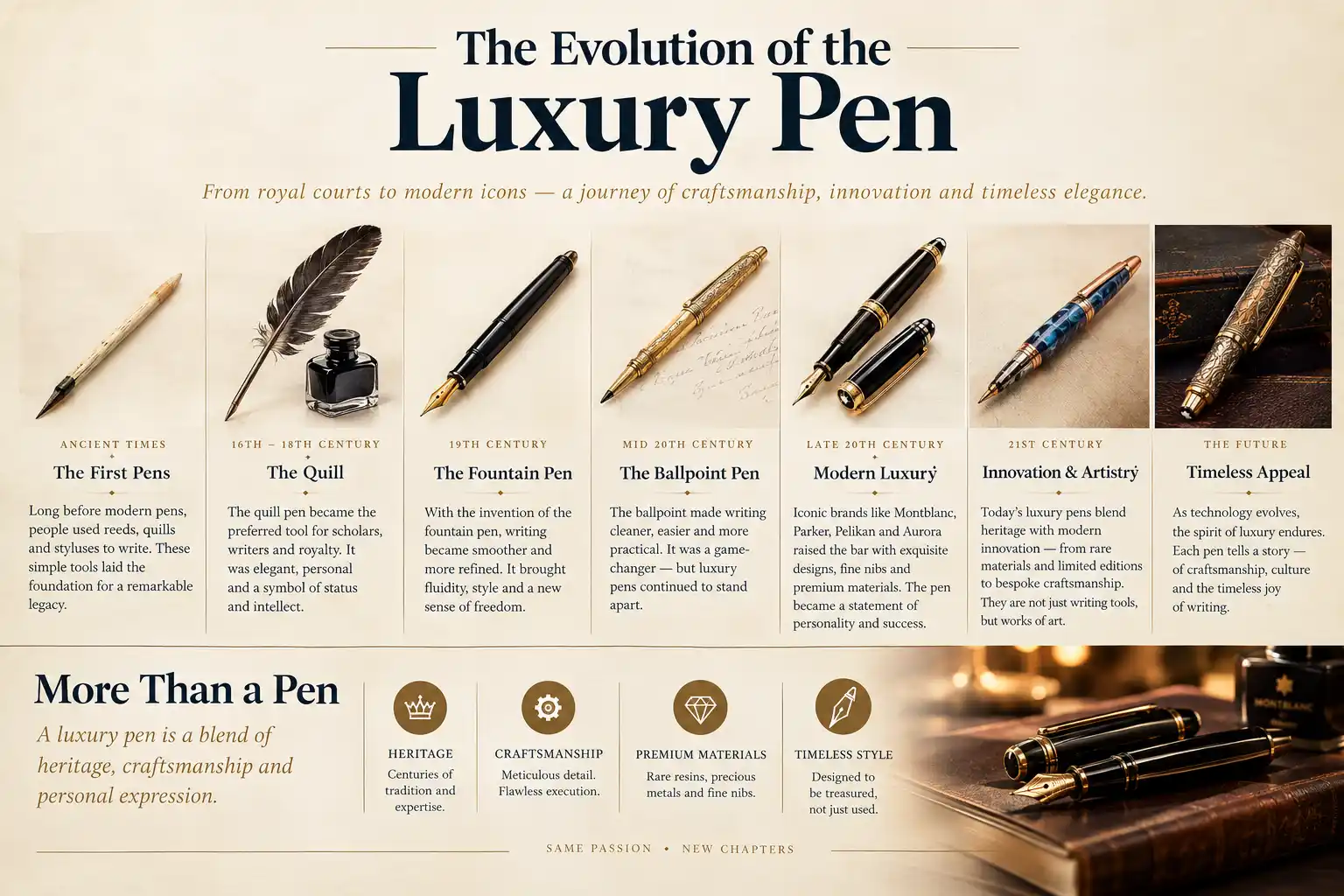
A luxury pen is rarely the most practical object on the desk. It is the one that makes you slow down, notice the weight in your hand and enjoy the act of writing.
Pen History Timeline
Here is the whole journey in one line.
- c. 3300 BCE onwardReed styluses in MesopotamiaEarly writing impressed into clay.
- Ancient Egypt onwardRush and reed pensThe first ink-carrying pens, used on papyrus.
- c. 6th to 7th century CE onwardQuill pensThe dominant tool for manuscripts and documents.
- 1820s to 1830sMass-produced steel nibsDurable, consistent and affordable writing.
- 1827Early fountain pen patent (Poenaru)The self-contained ink idea takes shape.
- 1884Waterman’s practical feedThe fountain pen becomes reliable.
- 1900s to 1930sGolden age of fountain pensMass adoption and fierce design competition.
- 1938 to 1950Ballpoint pensConvenient everyday writing for everyone.
- 1963 onwardRollerball pensSmooth, liquid-ink writing.
- 1980s onwardGel pensColour and smoothness.
- TodayLuxury and technical pensPerformance, craftsmanship and collecting.
Pen Types at a Glance
| Pen type | Approximate era | Ink system | Main advantage | Main limitation |
|---|---|---|---|---|
| Reed pen | Ancient | Dip ink | Simple construction | Frequent dipping |
| Quill | c. 6th to 7th century to 19th century | Dip ink | Flexible, fine writing | Constant recutting |
| Steel dip pen | 1820s onward | Dip ink | Durable and consistent | Still needs an inkwell |
| Fountain pen | 19th century onward | Internal reservoir | Continuous, expressive writing | Needs regular care |
| Ballpoint | 1930s to 1940s onward | Paste ink | Convenient and reliable | Firmer, less expressive feel |
| Rollerball | 1960s onward | Liquid or gel ink | Very smooth writing | Can use ink faster |
Frequently Asked Questions
What is the history of the pen?
Pens evolved from reed styluses and brushes in ancient civilisations to quills in medieval Europe, then steel nibs, fountain pens, ballpoints and rollerballs. Each step solved problems left by the last.
What was the first pen?
There is no single first pen. Mesopotamian reed styluses and Egyptian rush and reed pens are among the earliest tools, but they developed gradually.
What did people use before pens?
Fingers, brushes, bones, charcoal and pigments for early marks, and styluses on clay or wax for early writing.
Who invented the fountain pen?
No single person did. Ideas existed from the 10th century, Schwenter described a design in 1636, and Poenaru patented one in 1827. Lewis Waterman’s 1884 feed made the pen practical.
When was the fountain pen invented?
Its development spans centuries. The 19th century is when practical, commercial fountain pens emerged.
Who invented the ballpoint pen?
John J. Loud patented an early version in 1888, but László Bíró, with his brother György, developed the first practical ballpoint, patented in 1938.
When did ballpoint pens become popular?
After World War II, in the mid-to-late 1940s. They spread globally in the 1950s with low-cost models such as the Bic Cristal.
What is the difference between a quill and a fountain pen?
A quill is a dip pen cut from a feather and needs repeated dipping. A fountain pen holds ink in an internal reservoir and delivers it through a feed and a metal nib.
Why are fountain pens still popular?
They offer smooth, expressive writing, many nib and ink choices, and refillable, sustainable use. Many people simply enjoy the experience.
How have pens changed over time?
They moved from simple tools that needed constant dipping to self-contained, convenient and refined instruments, and from purely functional objects to collectible ones.
Sources and Further Reading
- Encyclopaedia Britannica: entries on the pen, the fountain pen and the ballpoint pen
- Smithsonian National Museum of American History: writing instrument collections
- The Pen Museum, Birmingham: history of the steel nib industry
- The British Library: manuscript and scribal tools
Why History Makes Better Writing
At The Pen Lounge, we believe writing is a small daily ritual, and the right instrument makes it a pleasure. Whether you are starting out or building a collection, the story behind a pen is part of its value. Explore more guides in our pen education library.