Fountain Pen Ink Types Explained: Dye, Pigment, Iron Gall, Wet vs Dry
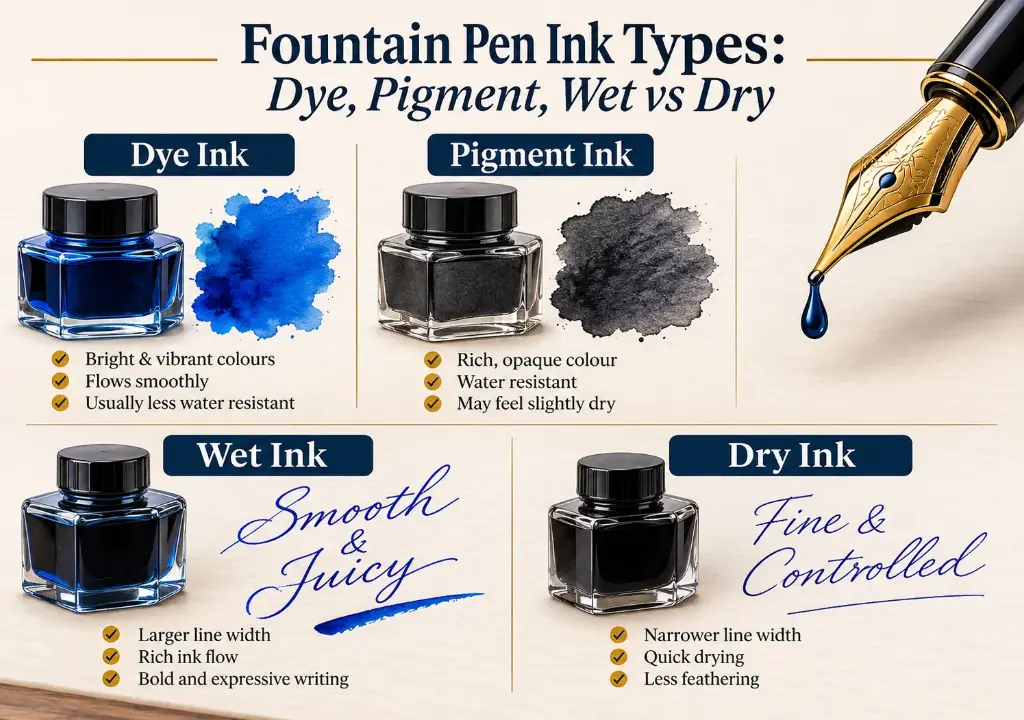
Not all fountain pen inks are the same. Some are dyes, some are pigments, some are iron gall, and some flow wet while others run dry. This guide explains the main fountain pen ink types in plain language, so you can pick an ink that suits your pen, your paper and the way you write.
By The Pen Lounge team | Updated 30 October 2026 | About 10 minutes to read
The short answer
Most everyday inks are dye-based: easy to clean, available in a huge range of colours and gentle on pens.
Pigment and iron gall inks resist water but need more care, so flush the pen more often.
Wet inks flow more and look richer but feather and show through on cheap paper. Dry inks flow less and dry faster, which suits thin paper and left-handed writers.
Sheen and shimmer inks look great but can clog narrow feeds. Use them in modern pens.
Never use drawing ink, India ink or other inks not made for fountain pens. Test any new ink on the back page first.
What is fountain pen ink made of?
Fountain pen ink is water-based. It contains a colourant (a dye or a pigment), water, and small amounts of additives that control how it behaves. These include surfactants that help ink spread and flow, humectants that slow drying so the nib does not clog, and biocides that stop mould. The exact recipe is a trade secret for most brands. For a general overview of how inks are made, see Wikipedia’s ink article.
Fountain pen ink is much thinner than ballpoint ink because it travels from the reservoir to the nib through the feed by capillary action. That is why using a thick or sticky ink can stop a pen from writing.
Tiny solid pigment particles are suspended in the liquid.
High once dry.
Can clog if left to dry in the pen. Flush often.
Forms, documents and layering with watercolour.
Iron gall
Iron salts and tannins react with air and darken over time. See iron gall ink.
Good after it dries and darkens.
Traditional formulas are acidic. Modern ones are milder, but rinse regularly.
Permanent records and careful users.
Sheen and shimmer
Highly saturated dye (sheen) or added metallic particles (shimmer).
Varies by ink.
Particles settle and can clog. Shake gently and flush often.
Modern pens and decorative writing.
Dye inks: the safe default
If you are not sure what to buy, buy a dye ink from a well-known fountain pen brand. Dye inks are forgiving, clean easily, and come in the widest colour range. Their weakness is that they can wash out when wet and fade in strong sunlight. Our beginner ink guide lists easy first choices.
Pigment inks: tougher, but fussier
Pigment inks sit on the paper surface instead of soaking in, which makes them highly water-resistant. The price is maintenance. If a pigment ink dries inside the feed, the particles can block it, so use the pen often and flush it with water every few refills.
Iron gall inks: old technology, modern versions
Iron gall ink was the standard writing ink for centuries. Writing starts pale, then darkens as the ink oxidises. Traditional formulas can corrode steel nibs and damage old pens if left for long, so many modern versions are milder. Treat them as an intermediate-level ink and rinse your pen regularly.
Wet vs dry ink: what the words mean
A “wet” ink delivers more ink to the page, and a “dry” ink delivers less. Wetness is not only about the ink. It comes from the ink, the nib and the feed working together, so a wet ink in a wet pen is very wet indeed.
Wetter ink
Drier ink
Flow
Generous and smooth
Lighter and more controlled
Line
Looks broader and darker
Looks finer and crisper
Drying time
Slower, so more smudging risk
Faster, so less smudging
On cheap paper
Feathers and shows through more
Behaves better
Sheen and shading
Usually more visible
Usually less visible
Good for
Fine nibs, smooth paper, colour lovers
Broad nibs, thin paper, left-handed writers
Are Diamine inks wet or dry? Diamine sells dozens of colours, so flow differs between them. Many are described by reviewers as medium to wet, but your nib and paper matter just as much. Read reviews for the exact colour and test it in your pen before you commit to a full bottle. The same advice applies to any large ink range.
A quick flow test
Write the same word with the same pen on the same paper using two inks. The wetter ink makes the wider, darker line and takes longer to dry. Swap the pen’s ink, not your paper, so the test is fair.
Which type of ink suits you?
Ink chooser
Answer three questions for a starting point. It is a rule of thumb, not a guarantee.
Best match: Standard dye-based ink.
Everyday dye inks are forgiving, clean out easily and suit almost every pen.
On cheap or thin paper, choose a drier ink and a fine nib. Wet and sheening inks feather and show through.
Test any new ink on the back page of a notebook first.
Sheen, shading and shimmer
Shading
Variation in colour intensity within a single stroke, darker where more ink pools. Wetter pens and broader nibs show it more.
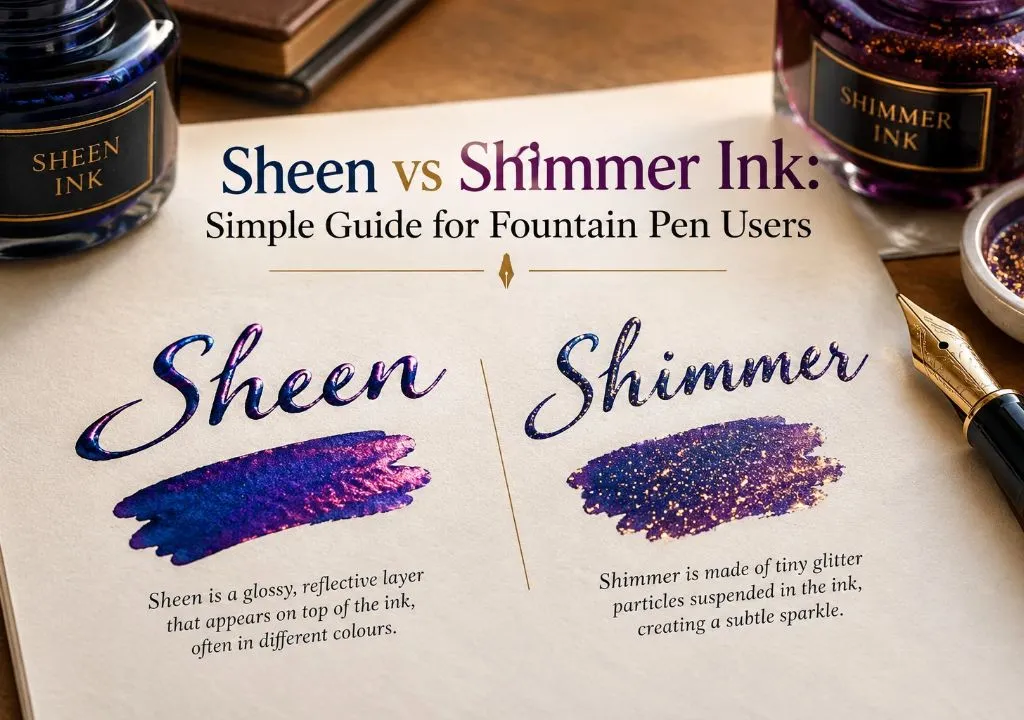
Sheen
A coloured shine, often reddish or gold, that appears on top of highly saturated ink when it dries. It shows best on smooth, coated paper.
Shimmer
Fine metallic particles suspended in the ink. They sparkle on the page but can settle at the bottom of the bottle and clog narrow feeds.
If you want to try sheen or shimmer, use a modern pen with a medium or broad nib, smooth paper, and flush the pen every couple of refills. Do not use them in vintage pens.
Drying time, smudging and water resistance
Do fountain pens smudge? Yes, they can. Smudging depends on how much ink reaches the page, how absorbent the paper is, and how fast you close the notebook. Left-handed writers drag their hand through fresh ink, so they tend to notice it more.
Choose a drier ink and a finer nib.
Use absorbent, uncoated paper. Very smooth, coated paper keeps ink wet for longer.
Let the line dry for a few seconds before turning the page, or blot it.
Water-resistant vs waterproof. No fountain pen ink survives every kind of soaking. Water-resistant ink usually stays readable after a splash, while a few specialist inks hold up better. Test your own: write a line, let it dry for a day, put a drop of water on it and blot after a minute.
What not to put in a fountain pen
Can drawing ink be used in fountain pens? No. Drawing ink, India ink and most calligraphy inks are made for dip pens and brushes. Many contain shellac or binders that dry hard and can destroy a feed.
India ink, drawing ink, and most calligraphy or technical inks.
Acrylic, shellac-based and permanent art inks.
Printer ink, ballpoint ink and marker ink.
Anything that does not say it is made for fountain pens.
Dye inks can fade over years in strong sunlight. If you write letters, journals or records you want to keep, store them away from direct light and choose inks described as lightfast or archival by the maker. Keep bottles tightly closed and away from heat so they do not evaporate or grow mould.
Switching ink types
Use up the ink or empty the pen.
Flush with lukewarm water until it runs clear. Pigment inks may need several rounds.
Shake out the water and fill with the new ink. A little water left behind will only dilute the first few lines.
Never mix inks in the pen. If you want a custom colour, mix in a separate container and test it first, as some mixes form sludge.
No. Use ink made for fountain pens. Drawing ink, India ink, calligraphy ink for dip pens, printer ink and ballpoint ink can clog or ruin a feed.
What is the best ink for writing?
For most people, a dye-based ink from a known fountain pen brand in blue or black is the safest, easiest choice. Our beginner guide lists good starting points.
Is dye or pigment ink better?
Neither is better in every case. Dye ink is easier and gentler on the pen. Pigment ink resists water better but needs regular flushing, so it suits people who write often and want durable lines.
Why does my ink look different when it dries?
Wet ink often looks darker and bluer. As it dries, colour can shift, sheen can appear, and some inks lose a little intensity. Paper also changes the look, with absorbent paper giving duller, more muted colour.
Is blue-black or black ink better?
It is a matter of taste. Blue-black was traditionally an iron gall ink that darkens after writing, while many modern blue-blacks are dye-based. Check the label to see which type it is.
Which fountain pen ink dries fastest?
Inks described as quick-drying or dry-flowing, used with a finer nib on absorbent paper, dry fastest. Wet inks on smooth coated paper take the longest.
Does fountain pen ink expire?
Sealed ink usually lasts for years. After opening, it can grow mould or thicken if contaminated or stored in heat. If it smells sour, has threads in it or looks cloudy, discard it.
Can I use fountain pen ink in a dip pen?
Yes, fountain pen ink generally works in a dip pen. The reverse is not true, because dip pen and calligraphy inks can damage a fountain pen.
The Pen Lounge team. We sell pens, notebooks and journals from Thane, and write these guides for people choosing their first or next pen. Questions? Visit the shop or tell us what you would like covered next.
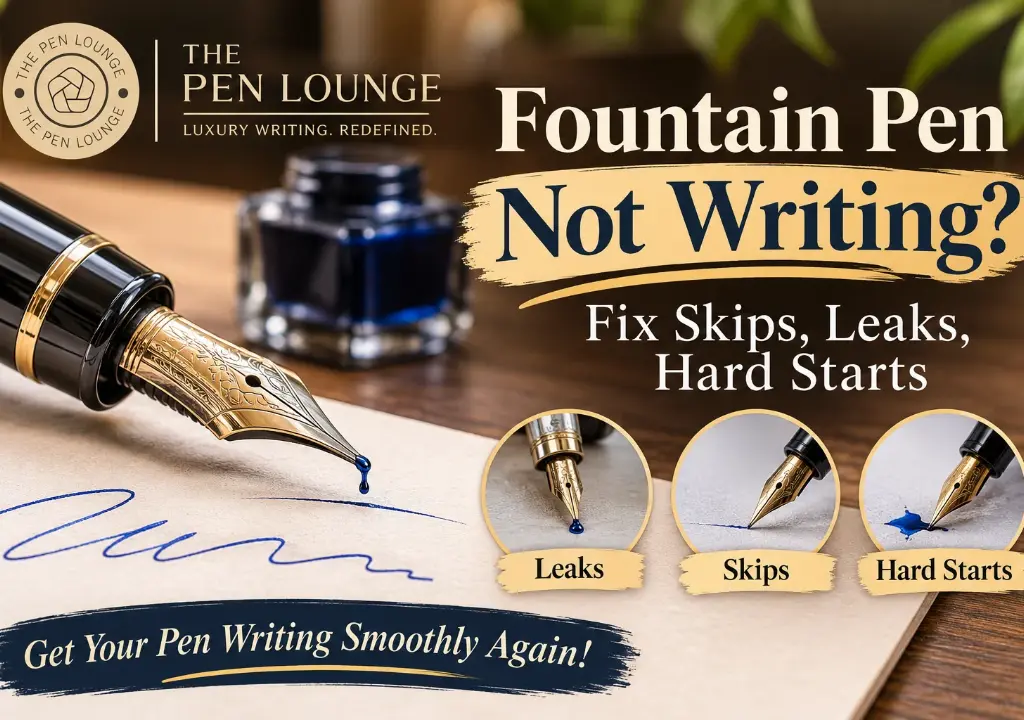
A fountain pen that skips, will not start or leaks is almost always fixable at home. This guide shows how to diagnose each problem, in order, from the simplest fix to the point where it is time to see a repairer. It is a practical fountain pen troubleshooting guide, with a symptom finder and a cleaning routine you can follow.
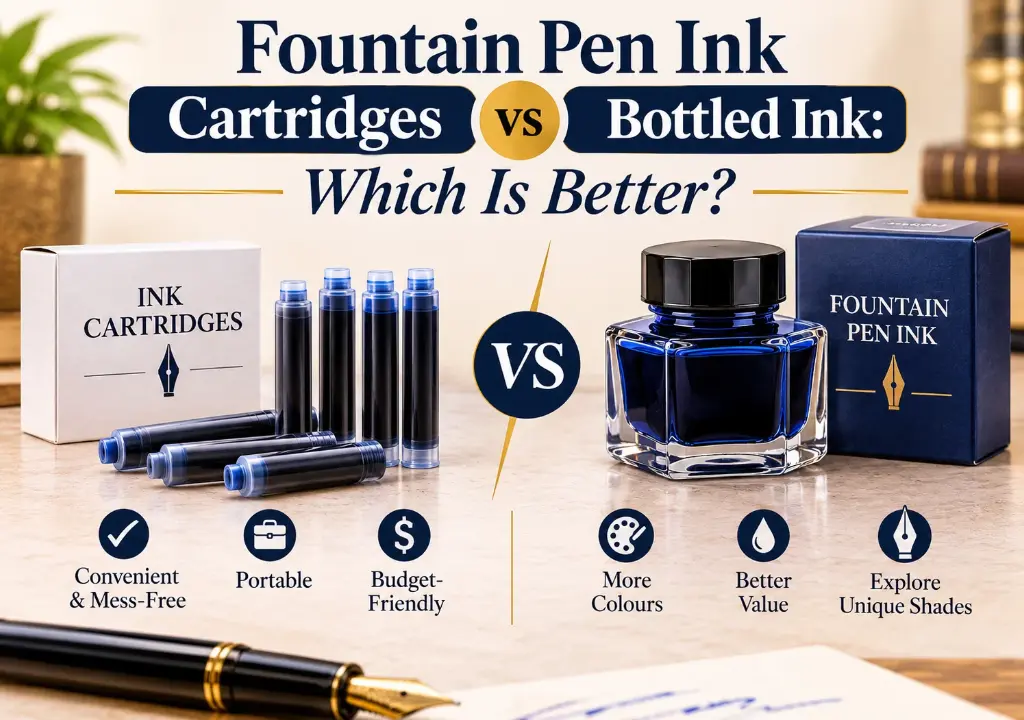
A fountain pen can drink from a sealed cartridge or from a bottle through a converter. Both work well. This guide explains the real differences in cost, mess, colour choice and compatibility, so you can choose the right fountain pen ink cartridges or bottled ink for your pen and your routine.
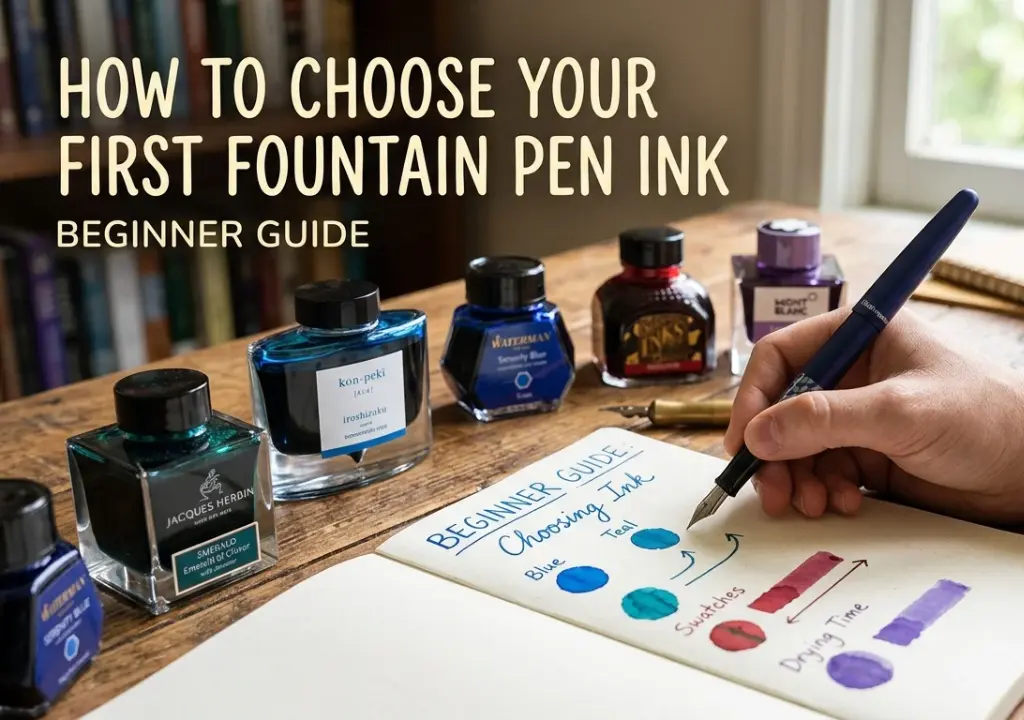
The best first fountain pen ink is a water-based dye ink in blue, blue-black or black, from a trusted brand, in a small bottle. It flows smoothly, cleans out easily and forgives beginner mistakes. Here is how to choose it in six simple steps, and which inks to avoid at the start.
You open a bottle of fountain pen ink and the description says “shading, sheen and shimmer”. It sounds technical, but it isn’t. Sheen vs shimmer ink is one of the most common beginner questions, so here is the difference in plain words, and which kind to pick.