Notebook Buying Guide: GSM, Paper Type, Ruling, Size and Binding
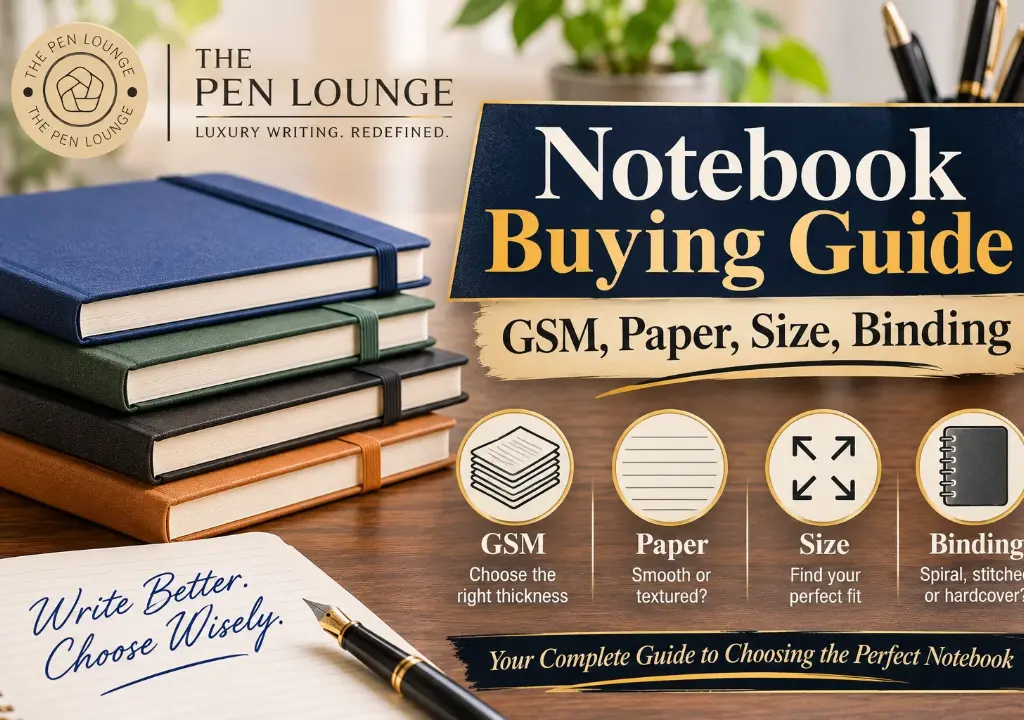
A notebook looks simple until you try to choose one. Paper weight, coating, ruling, size and binding all change how it feels to write in. This notebook buying guide explains each term in plain language and shows you how to match a notebook to your pen, whether you use a gel pen, a ballpoint or a fountain pen.
By The Pen Lounge team | Updated 30 October 2026 | About 8 minutes to read
The short answer
GSM (grams per square metre) measures paper weight. Higher usually means thicker and less show-through, but coating and sizing matter as much as weight.
For fountain pens, look for smooth, well-sized paper. 80 gsm and above is a good rule of thumb, and some thin coated papers also work.
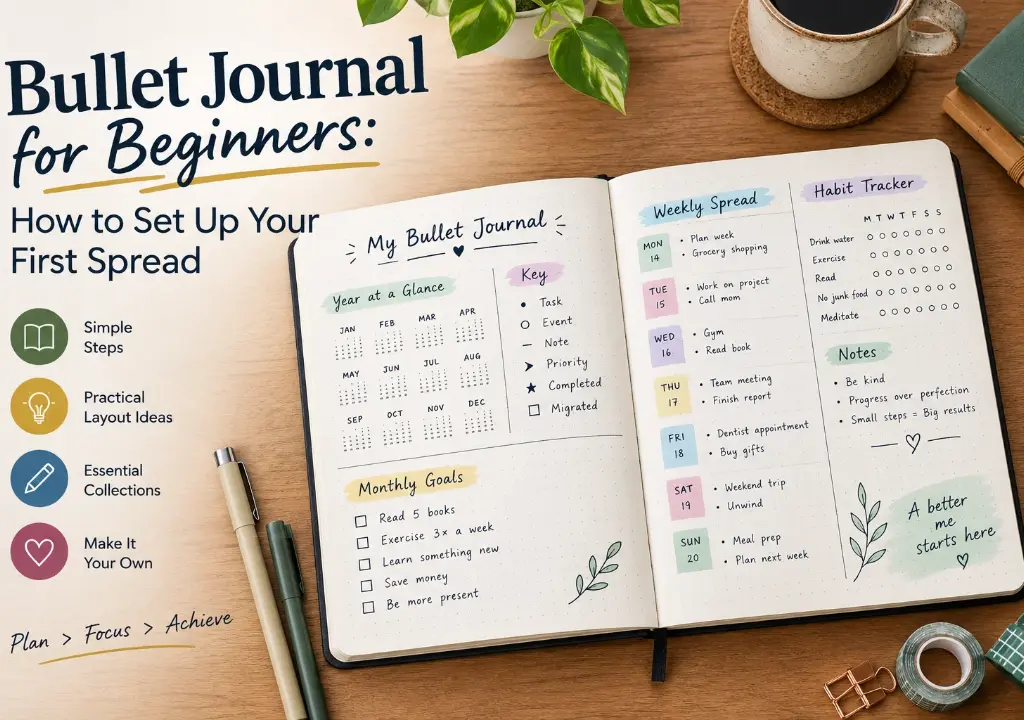
Ruled suits notes, dot grid suits planning and bullet journals, and blank suits sketching.
A5 is the popular balance between writing space and portability.
Sewn or stitched bindings last longest, while spiral bindings lie flattest.
Always test a page at the back before committing.
What does GSM mean?
GSM stands for grams per square metre, the weight of one square metre of the paper. It is the standard way to describe how heavy and thick a paper is. See Wikipedia’s grammage article for details.
GSM range
Feel and typical use
Pen suitability
Under 60
Very thin. Dictionaries, budget pads, some specialist journals.
Fine for pencils and ballpoints. Only coated thin papers suit fountain pens.
60 to 80
Typical school and office notebooks.
Fine for ballpoints and gel pens. Fountain pens may show through.
81 to 100
Better everyday notebooks and planners.
Good for most pens, including fountain pens on sized paper.
101 to 120
Premium journals and notebooks.
Very good for fountain pens and wetter inks.
Over 120
Sketchbooks, mixed media and heavy art paper.
Great for wet media. Check smoothness for writing.
GSM is not everythingSome very thin papers (for example, some Japanese papers around 52 to 68 gsm) are excellent for fountain pens because of how they are coated. A heavy but absorbent paper can still feather. Look at the finish, not just the number.
Paper surface and finish
Feature
What it is
Effect on writing
Coated or sized
A thin surface layer that stops ink from soaking in.
Crisp lines, slower drying, more sheen.
Uncoated
Plain paper with no surface layer.
Dries faster, but absorbs more ink and can feather.
Smooth
Fine surface with little “tooth”.
Glides, and suits fountain and gel pens.
Textured
Rougher surface with more tooth.
Feels grippy, great for pencils and sketching.
Cream vs white
Colour of the paper.
Cream reduces glare. White gives higher contrast.
Recycled
Made partly from recycled fibre.
Can be more absorbent, so test it with your pen.
Acid-free
Free of acidic compounds.
Lasts longer and resists yellowing.
Feathering, show-through and bleed-through
Feathering
Ink spreading into tiny hairs along the line. Caused by absorbent paper or very wet ink.
Show-through (ghosting)
You can see the writing on the back of the page, but the ink has not soaked through.
Bleed-through
Ink soaks through to the other side and leaves marks or holes in the fibre.
Wet inks, broad nibs and felt-tip pens are the biggest causes. For help on ink choice, read our ink types guide.
Paper and pen compatibility checker
Will my pen work on this paper?
A rule-of-thumb estimate, not a lab test. Always try a page at the back first.
Feathering: MediumShow-through: MediumBleed-through: Medium
Usable with care. Test a page first, and avoid writing on both sides if ghosting bothers you.
Ruling and layouts
Layout
What it is
Best for
Ruled or lined
Horizontal lines. Narrow, wide and single-line spacing exist.
Class notes, meetings, everyday writing
Four-line
Four guide lines per row.
Handwriting practice for children
Squared or grid
Small squares across the page.
Maths, diagrams, tables
Dot grid
A grid of dots with no lines.
Bullet journals, planning, sketching with structure
Blank
No marks.
Drawing, free writing, art
Cornell
Page divided into notes, cues and summary.
Study notes
Planner or dated
Pre-printed days, weeks or months.
Schedules and habit tracking
Light grey rulings are better than dark ones, because they do not compete with your writing.
Sizes: A4, A5, A6 and more
Most notebooks follow the ISO A series, where each size is half the previous. See ISO 216 and paper size.
Size
Dimensions
Typical use
A4
210 × 297 mm
Desk work, large notes, documents
B5 (ISO)
176 × 250 mm
Students who want slightly more space than A5
A5
148 × 210 mm
The all-rounder. Fits bags and desks.
A6
105 × 148 mm
Pocket notes, travel, quick lists
A7
74 × 105 mm
Tiny jottings and address books
Binding types
Binding
How it works
Pros
Cons
Perfect bound (glued)
Pages glued into a spine.
Cheap, neat spine
Pages can come loose; does not lie flat
Stapled (saddle-stitched)
Pages folded and stapled.
Thin, light
Not for thick notebooks
Section-sewn
Groups of pages sewn together.
Very durable, lays flatter
Costs more
Case-bound hardcover
Sewn pages with a hard cover.
Long-lasting, sturdy
Heavier
Spiral or wire-o
Pages punched and held by a coil.
Lies completely flat
Coil can catch; wrist rests on it
Disc-bound
Pages held by discs that can be moved.
Reorderable pages
Needs special punched paper
Thread-bound or traveller’s style
Inserts held in a cover with elastic.
Flexible, refillable
Thinner inserts only
Handy features
Ribbon bookmark: keeps your place.
Elastic closure: holds the notebook shut in your bag.
Pocket in the back cover: for loose notes and receipts.
Numbered pages and an index: useful for bullet journals.
Perforated pages: tear out neatly, if you like.
Choosing by use
If you are…
Look for
Avoid
A student
A5 or B5, ruled, stitched or sewn, 70 to 90 gsm
Thin, bleeding paper
In meetings or at work
A5, ruled, spiral or sewn, lay-flat
Glued spines that crack
A bullet journaller
A5 dot grid, sewn, 100 gsm or more, page numbers
Thin, ghosting paper
A fountain pen user
Smooth, sized paper, 80 to 120 gsm, or a coated thin paper
Rough, recycled absorbent paper
A sketcher
Blank, 120 gsm and above, textured for pencil
Very smooth thin paper
Left-handed
Lay-flat, sewn or case-bound, with a spine that does not dig in
Scribble on the back page with your usual pen and a wet, broad pen.
Check the reverse side for ghosting or bleed-through after a minute.
Look for feathering around letters and fine lines.
Smear test: rub the line after 10 seconds to check drying time.
Bend the spine gently to see whether it lies flat.
Check the ruling: it should be light and even.
Caring for notebooks in humid weather
Paper absorbs moisture from the air. In monsoon or coastal humidity, notebooks can swell, curl and feel more absorbent. Store them in a cool, dry place, away from direct sun and damp walls. A silica gel packet in a drawer or box helps. Use fresh notebooks for important writing if the weather has been damp.
A rule of thumb is 80 gsm or more on smooth, well-sized paper. Thinner papers can work if they are coated for ink, so check the finish as well as the number.
Is higher GSM always better?
No. Heavier paper reduces show-through, but a heavy, rough or absorbent paper can still feather. Coating and sizing matter as much as weight.
What does A5 mean?
A5 is a standard size of 148 × 210 mm, half of A4. It is one of the most popular notebook sizes.
What is a dot grid notebook?
It is a notebook with a grid of dots instead of lines. It gives structure for planning, lists and sketching without heavy lines on the page.
Which notebook is best for bullet journaling?
Look for A5 dot grid, sewn binding, 100 gsm or more, numbered pages and a ribbon. Test pages with your pens before you commit.
Why does my ink show through the page?
The paper is too thin or the ink is too wet. Use a drier ink, a finer tip or a heavier, better-sized paper. See our ink types guide.
Are recycled notebooks bad for fountain pens?
Not always, but recycled paper is often more absorbent, so ink may feather. Test a page first, and use a finer nib and drier ink if needed.
What is the difference between a notebook and a journal?
The words overlap. Journals tend to have better paper, sturdier binding and fewer rulings, while notebooks are often built for everyday notes at a lower cost.
The Pen Lounge team. We sell pens, notebooks and journals from Thane, and write these guides for people choosing their first or next pen. Questions? Visit the shop or tell us what you would like covered next.
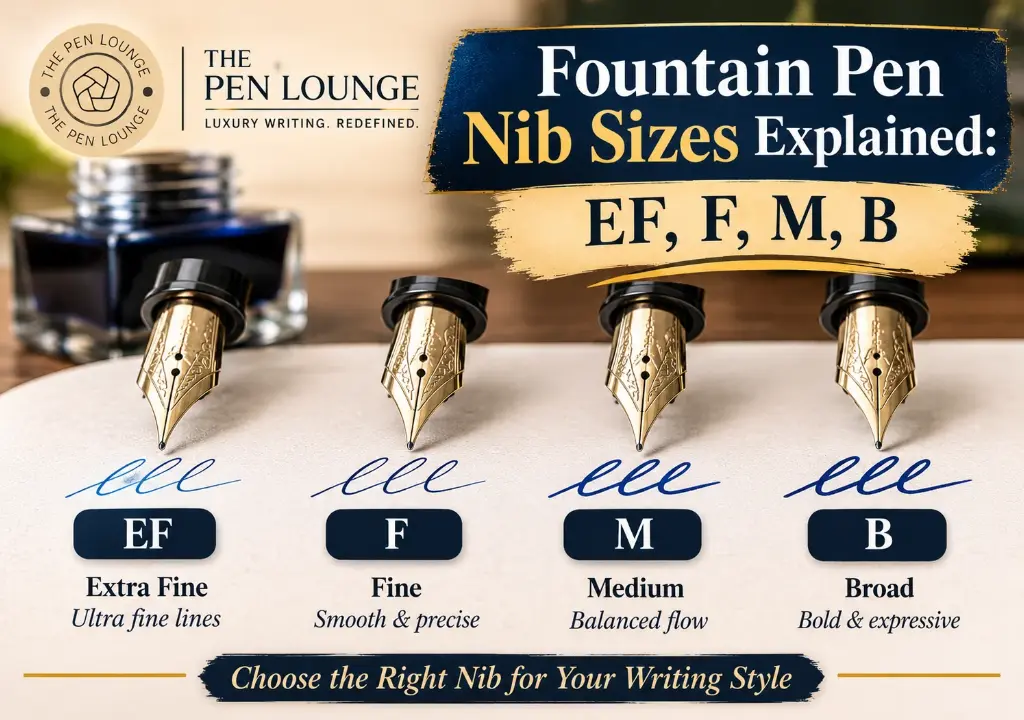
The nib size decides how thick your line is, how your handwriting looks and how the pen behaves on paper. This guide explains fountain pen nib sizes from extra fine to broad, plus stub, italic and flex nibs, and shows you how to choose one.
The method was created by Ryder Carroll as a way to organise notes, tasks and events in one notebook. You don’t need artistic skill or fancy supplies. A plain page with short, quick entries is exactly what the system asks for, and it is called rapid logging.