Fountain Pen Nib Sizes Explained: EF, F, M, B and Stub
The nib size decides how thick your line is, how your handwriting looks and how the pen behaves on paper. This guide explains fountain pen nib sizes from extra fine to broad, plus stub, italic and flex nibs, and shows you how to choose one.
By The Pen Lounge team | Updated 30 October 2026 | About 7 minutes to read
The short answer
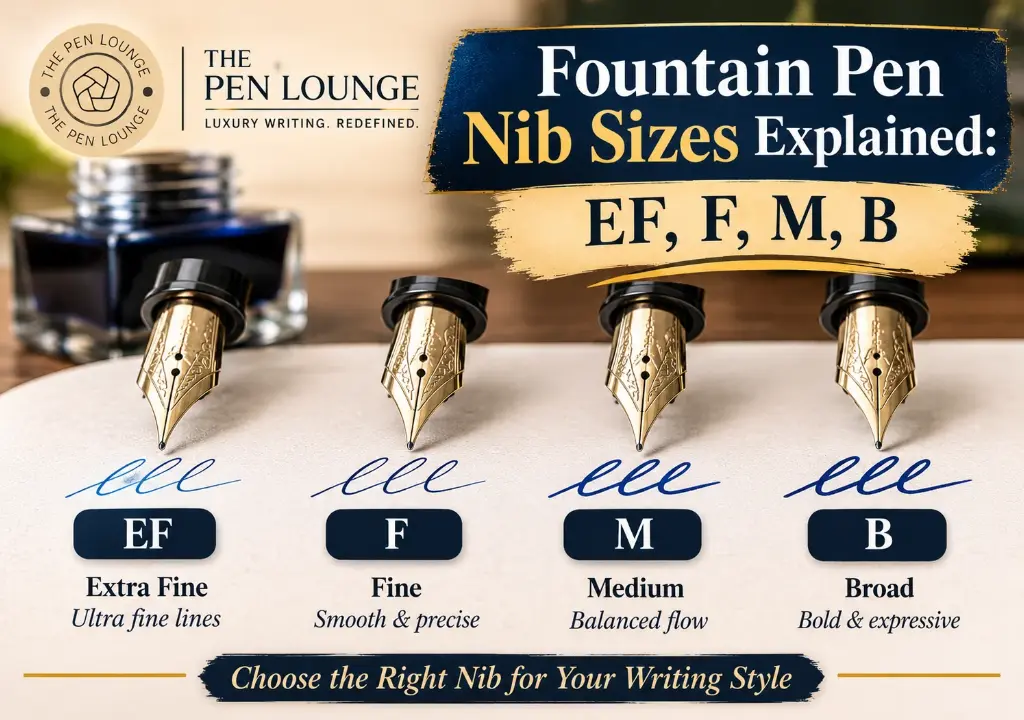
The common sizes run EF (extra fine), F (fine), M (medium) and B (broad), from narrowest to widest.
Sizes are not standard. A Japanese nib usually writes finer than a European nib with the same letter, so compare millimetre widths when a listing gives them.
Fine nibs suit small handwriting and thin paper. Medium suits most people. Broad shows off ink but needs good paper.
Stub, italic, oblique and flex nibs change the line shape. They are fun, but not the best first nib.
Never press on a nib to “test” flex. It is the most common way nibs get ruined.
What is a nib size?
The nib is the metal tip that touches the paper. Its size describes how wide a line it draws. The width comes from the shape of the tipping (the small bead of hard metal at the end), the nib’s flexibility, the feed and the ink, plus how hard and at what angle you write. Read more on Wikipedia’s nib article.
Nib size chart: EF, F, M and B
These are typical line widths in millimetres. They are a guide, not a promise, because every maker grinds nibs a little differently.
Size
Japanese (typical)
European (typical)
Feels like
Good for
EF (extra fine)
0.2 to 0.3 mm
0.4 to 0.5 mm
Precise, can feel scratchy
Tiny handwriting, margins, thin paper
F (fine)
0.3 to 0.4 mm
0.5 to 0.6 mm
Crisp and controlled
Everyday notes, most Indian notebooks
M (medium)
0.4 to 0.55 mm
0.6 to 0.8 mm
Smooth and forgiving
General writing, journals, good paper
B (broad)
0.6 to 0.8 mm
0.9 to 1.2 mm
Wet and cushioned
Signatures, large handwriting, showing off ink
See the difference: nib size visualizer
Nib width visualizer
Pick a style and a size to see an approximate line. It is drawn larger than life so you can compare.
Japanese F: typical line width about 0.3 to 0.4 mm.
Shown larger than life so you can compare. Real widths vary by maker, ink and paper.
Why Japanese and European sizes differ
Japanese makers such as Pilot, Sailor and Platinum grind their nibs finer, partly because Japanese writing uses small, detailed characters. As a result, a Japanese medium can look like a European fine. If you want the line of a European fine, a Japanese medium is often close.
Budget brands often list widths directly. For example, many Hongdian pens are sold in sizes such as 0.38 mm and 0.5 mm. For “Hongdian fine vs extra fine”, the extra fine is the narrower one. Always compare the millimetre numbers in the listing, not just the letters.
Nib shapes and grinds
Shape
What it does
Who it suits
Round (standard)
Even line in every direction
Almost everyone, and the best first nib
Stub
Wider on down strokes, narrower on cross strokes, with soft edges
Journaling and handwriting with character
Italic or cursive italic
Crisp edges with a clear thick and thin contrast
Calligraphy and lettering. Common widths include 1.1, 1.5 and 1.9 mm
Oblique
Tip angled to the side
Writers who hold the pen at an unusual angle
Flex
Springy tines spread under pressure for a thicker line
Experienced writers. Easy to damage
Music or architect
Wide, specialised grinds, such as three-slit music nibs
Collectors and special uses
Do not test flex by pressing
Pressing too hard spreads the tines permanently. If you are buying a flex nib, ask for a video of it being used, and write with light pressure.
Steel, gold, titanium
Material
Feel
Notes
Steel
Firm and durable
Affordable. Used on most pens, from school pens to quality brands.
Gold (14K, 18K, 21K)
Softer, more cushioned
Usually stamped 585 or 14K, and 750 or 18K. More expensive to replace.
Titanium
Light and springy
Used on some modern pens.
A gold nib is not automatically better than steel. A well-made steel nib can outwrite a poor gold one. For help judging a nib on a used pen, read our pre-owned fountain pen guide.
How to choose a nib size
Your situation
Try
Why
Small handwriting or narrow ruling
EF or F
Keeps letters open and legible
Everyday notes on ordinary paper
F or a Japanese M
Good balance of control and smoothness
Journaling on smooth, good paper
M or B
Shows off colour, shading and sheen
Thin or absorbent notebook paper
F plus a drier ink
Wide, wet lines feather and show through
Left-handed writer
F or M plus a quick-drying ink
Less smudging and less ink on the hand
Calligraphy
Italic 1.1 to 1.9 mm
Made for thick and thin strokes
A lot of everyday notebook paper is thin and absorbent, so finer nibs and drier inks tend to behave best. Our notebook paper guide explains why, and our ink types guide shows how wet and dry inks differ.
Testing a nib before you buy
Hold the pen as you normally write and use your usual pressure.
Write your own words, not a signature or scribble, on paper like yours.
Try quick and slow strokes to check for skipping, hard starts and scratchiness.
Read the nib stamp for size and metal, and check that both tines meet evenly.
Buying online? Ask for the width in millimetres, a handwritten sample, and the return policy.
Caring for your nib
Write with light pressure and let the nib do the work.
Rinse the pen regularly and do not let ink dry in the feed.
Do not pull a nib apart to “fix” it unless you know the pen.
Some pens, such as the Lamy Safari, have a replaceable nib unit, so changing size can be easy.
Fine or medium is usually easier, because they are smoother and more forgiving. Extra fine nibs can feel scratchy if you press hard or hold the pen at an unusual angle.
What nib size is best for everyday writing?
A fine nib, or a Japanese medium, suits most people on typical paper. Move to medium or broad if you write large or use smooth paper.
What nib size is best for left-handed writers?
Fine to medium nibs with a quick-drying ink tend to work well, because they smudge less. Test a pen with your normal grip if you can.
Hongdian fine vs extra fine: what is the difference?
Extra fine is the narrower line. Compare the millimetre widths in each listing, because exact sizes vary by model.
Are nib sizes standard across brands?
No. Each maker grinds its own sizes, and Japanese nibs are generally finer than European nibs with the same letter. Use millimetre widths and writing samples when you can.
Can I change the nib size later?
On some pens, yes. Pens with a swappable nib unit make it easy, and a repairer can sometimes regrind a nib. On many pens, the simplest option is to buy a different pen.
Do gold nibs write better than steel?
Not always. Gold nibs are often softer and more cushioned, but a well-made steel nib can write beautifully. Judge by how the pen writes, not just the metal.
Are broad nibs harder to use?
Not harder, but they use more ink, show more feathering on cheap paper and dry slower. They suit smooth paper and larger handwriting.
The Pen Lounge team. We sell pens, notebooks and journals from Thane, and write these guides for people choosing their first or next pen. Questions? Visit the shop or tell us what you would like covered next.
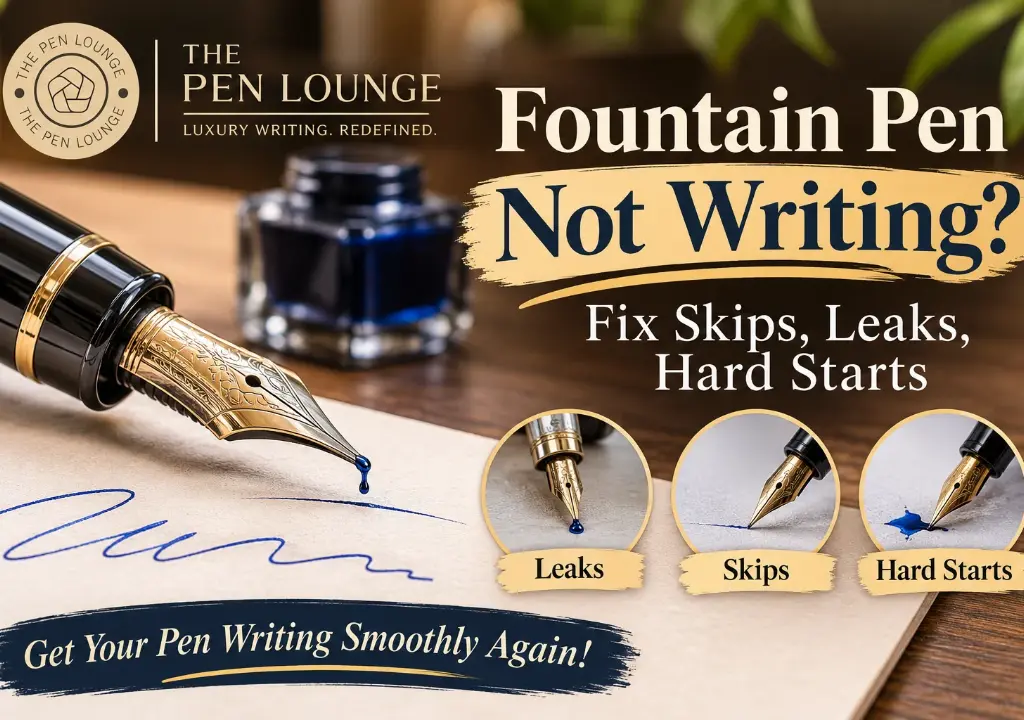
A fountain pen that skips, will not start or leaks is almost always fixable at home. This guide shows how to diagnose each problem, in order, from the simplest fix to the point where it is time to see a repairer. It is a practical fountain pen troubleshooting guide, with a symptom finder and a cleaning routine you can follow.
A notebook looks simple until you try to choose one. Paper weight, coating, ruling, size and binding all change how it feels to write in. This notebook buying guide explains each term in plain language
Every pen puts ink on paper, but they do it in very different ways. This guide explains the main types of pens, how each one works, what it is best at, and how to pick the right one for notes, exams, signatures, journaling or a gift.
A fountain pen can drink from a sealed cartridge or from a bottle through a converter. Both work well. This guide explains the real differences in cost, mess, colour choice and compatibility, so you can choose the right fountain pen ink cartridges or bottled ink for your pen and your routine.